Talk About…God Music: Golden Calf, Gold Whop Whop Whop

We are exploring what the Bible has to say about the relationship between worship and music. Last time we looked at the first instance recorded in the Bible of God’s people in worship (Exodus 15 The Lord had just parted the Red Sea and the children of Israel had escaped the pursuing Egyptian army). Although there is, to be sure, a lot more that could be said in regards to this passage, we came away with the following observations:

1) Worship (including singing, music, and dancing) is a natural response to salvation.

2) Worship is not a spectator sport.

3) Worship (and the music that accompanies it) is to be 100% God centered.

Now, here we are in Exodus 32. Perhaps a year had gone by (not quite sure of exact time), and we find the Israel camped out at Sinai. They had seen God’s provision over the past year. They had eaten Manna, drank water from the Rock, dined on meat that God rained on them, and defeated Amalek in battle. We find in Exodus 32 that Moses had gone up the mountain to meet with God, leaving the people down below.
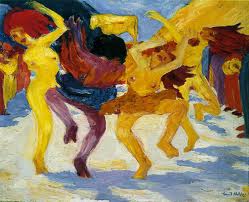
“When the people saw how long it was taking Moses to come back down the mountain, they gathered around Aaron. “Come on,” they said, “make us some gods who can lead us. We don’t know what happened to this fellow Moses, who brought us here from the land of Egypt.” (v1)  Aaron makes an golden calf, offers it as a physical representation of God, builds an altar, declares a feast (to the Lord), and the people offer burnt offerings and peace offerings. So, “the people sat down to eat and to drink, and rose up to play”

God informs Moses of what is going on, and as he and Joshua make their way down the mountain, Joshua thinks he hears the sound of war in the camp. However, Moses says, “It is not the sound of the cry of triumph, nor is it the sound of the cry of defeat; but the sound of singing I hear.” Okay, so what can we learn from this account that helps us as we talk about God music?

Keep in mind the same people were involved in this incident (at least a great deal of them were) as in Exodus 15. They still employed the same musical style as when they had previously worshiped God after crossing the Red Sea; however, here they are using their music in an idolatrous way. I think a question should be asked at this point. What makes their singing acceptable as worship in Exodus 15 and idolatrous in Exodus 32? What constitutes God music versus golden calf music? Yeah, you know; it is the object of worship and the disposition of their hearts.

In Exodus 15, the people were singing to God and about God. Their hearts were exalting him as the only true, holy, eternal God. The utilized their music and singing to glorify his name. God had wrought a great deliverance and they celebrated their Deliverer with the musical style that was indigenous to their culture. Around the golden calf, we find a people who had become impatient, setting aside all that God had done for them and crafting for themselves a “right now god” they didn’t have to wait on, a god they could see. They made for themselves a god that would meet their emotional needs of the moment. It doesn’t even appear that they were attempting to cast aside Yahweh, but rather desired to make him who they wanted him to be, and worship him they way they wanted to worship him- same people, same musical style, but idolatrous in its essence.

I don’t even pretend to think we have exhausted everything we could glean from this passage, but let’s stop here. What have we observed from the golden calf incident that helps us in our little study? How about the following: Musical style is not the defining element of authentic worship. The same style of music can be used in both the true, spiritual worship of God, and idolatrous abandon. It is the Object of worship and the disposition of the heart that makes God music.

To be continued…
Talk About… God Music

There seems to be increasing controversy within the Church about music, and the role it plays in our “worship services” today. What style of music should be played? Are there any limitations as to the types of instruments that may be used? Is it to be the traditional choir & hymns scene, or should we opt for the “praise band,” and contemporary songs.? Is it okay to have music period? There is certainly a lot of talk about God music today, but what does God have to say about music? As always, we need to lay our presuppositions and our personal preferences before the Lord, and take a look into the Bible to see what it has to say (sola scriptura) about the relationship between music and worship.

The first place we encounter music & singing in the Bible is in Exodus 15. The Lord had just parted the Red Sea and the children of Israel had escaped the pursuing Egyptian army. This is how it reads,

“Then Moses and the people of Israel sang this song to the Lord:

“I will sing to the Lord,
for he has triumphed gloriously;
he has hurled both horse and rider
into the sea.
The Lord is my strength and my song;
he has given me victory.
This is my God, and I will praise him—
my father’s God, and I will exalt him!
The Lord is a warrior;
Yahweh is his name!
Pharaoh’s chariots and army
he has hurled into the sea.
The finest of Pharaoh’s officers
are drowned in the Red Sea
The deep waters gushed over them;
they sank to the bottom like a stone.

“Your right hand, O Lord,
is glorious in power.
Your right hand, O Lord,
smashes the enemy.
In the greatness of your majesty,
you overthrow those who rise against you.
You unleash your blazing fury;
it consumes them like straw.
At the blast of your breath,
the waters piled up!
The surging waters stood straight like a wall;
in the heart of the sea the deep waters became hard.

“The enemy boasted, ‘I will chase them
and catch up with them.
I will plunder them
and consume them.
I will flash my sword;
my powerful hand will destroy them.’
10 But you blew with your breath,
and the sea covered them.
They sank like lead
in the mighty waters.

11 “Who is like you among the gods, O Lord—
glorious in holiness,
awesome in splendor,
performing great wonders?
12 You raised your right hand,
and the earth swallowed our enemies.

13 “With your unfailing love you lead
the people you have redeemed.
In your might, you guide them
to your sacred home.
14 The peoples hear and tremble;
anguish grips those who live in Philistia.
15 The leaders of Edom are terrified;
the nobles of Moab tremble.
All who live in Canaan melt away;
16     terror and dread fall upon them.
The power of your arm
makes them lifeless as stone
until your people pass by, O Lord,
until the people you purchased pass by.
17 You will bring them in and plant them on your own mountain—
the place, O Lord, reserved for your own dwelling,
the sanctuary, O Lord, that your hands have established.
18 The Lord will reign forever and ever!”

19 When Pharaoh’s horses, chariots, and charioteers rushed into the sea, the Lord brought the water crashing down on them. But the people of Israel had walked through the middle of the sea on dry ground!

20 Then Miriam the prophet, Aaron’s sister, took a tambourine and led all the women as they played their tambourines and danced. 21 And Miriam sang this song:

“Sing to the Lord,
for he has triumphed gloriously;
he has hurled both horse and rider
into the sea.”

It would seem that singing and music were already a part of the people’s lives prior to the Exodus. We are not told how they knew to sing; we are just told that they sang. What can we learn about music and worship from this scenario that would be applicable to us today?  First, I think we should take note that the natural response to salvation is worship. The people had just experienced a mighty deliverance, and they sang in worship to God. Also, EVERYBODY joined in. It wasn’t just Moses and a select few; “the people of Israel” sang to the Lord. As far as we can tell everyone participated. It seems that no one had the “entertain me” mentality. It was truly a corporate experience.

Furthermore, we observe that this song was all about God. The lyrics exalted the Lord as the only true God, sovereign, holy, and glorious. They are singing to the Lord and about him. The song is prophetic in nature in that it foresees that God will “bring them in and plant them on your own mountain— the place, O Lord, reserved for your own dwelling, the sanctuary, O Lord, that your hands have established.” The first song recorded in the Bible was entirely theocentric. We can also see that at the first “worship service” recorded in the Bible, instruments were used, and dancing took place.

So, although we have only begun our look into the relationship between music and worship, I think we can say the following:

1) Worship (including singing, music, and dancing) is a natural response to salvation.

2) Worship is not a spectator sport.

3) Worship (and the music that accompanies it) is to be 100% God centered.

To be continued…