Burning Down the House

Newton’s Third Law of Motion states that “for every action there is an equal and opposite reaction.” It should therefore come as no surprise that the staunch traditionalism and impotency of the evangelical institutional church is now encountering such forceful resistance. Religion is big business, and the people who attend the “churches” have been reduced to being the means by which said business is perpetuated. However, for those who advocate “burning down the house,” perhaps the question of motivation should be addressed.

The story is told of a couple’s divorce and the resulting alienation of the children from the one parent by the custodial parent. The non-custodial parent was pleading his/her case as to interaction with the children, and stated, “Why do you keep me from the children? They need me and I need them. You say you love them and want what’s best for them, but I think the reality is that you really hate me far more than you love them.”

Sadly, in many cases, those who vehemently oppose the “traditional church” are more consumed by their hatred for the institution than their love for the body of Christ. Often, they have been hurt, abused, and overlooked resulting in bitterness taking root inside them. Yes, they see the legitimate deficiencies of the institutional church, but they have become more motivated by their pain produced hatred than authentic love. The scripture warns us of being hardened by the deceitfulness of sin. Sometimes it is easier to hide our pain behind supposed revelation and prophetic insight than it is to allow the Spirit of God to bring healing and remove the splinter of hatred that has become lodged within us.

It has been said that every rebel is a closet aristocrat. So often, when encountering institutional revolutionaries, you come away with the feeling that if someone had just acknowledged them, and given them a position of authority, they would have remained “in the fold.” Many decry the institutional church, leave and start a home-church, storefront- church, etc…; and fail to see that all they have done is recreated what they profess to hate so much. The only difference is now, in the new “community,” they are in charge. We must ask ourselves, “Am I motivated by love for the Body, or selfish ambition?”

My dear brothers and sisters, becoming “un-institutionalized” is more than just finding a new meeting place and burning down the old house. An institution is defined as the following:

1. an organization, establishment, foundation, society, or the like, devoted to the promotion of a particular cause or program, especially one of a public, educational, or charitable character.

2. the building devoted to such work.

3. a public or private place for the care or confinement of inmates, especially mental patients or other disabled or handicapped persons.

4. a well-established and structured pattern of behavior or of relationships that is accepted as a fundamental part of aculture, as marriage: the institution of the family.

5. any established law, custom, etc.

So often our pain and bitterness blinds us to the reality that all we really desire is another institution, one that functions the way I want it to.

In our present context, there is only one “institution” that truly matters- the Body of Christ. This institution is organic, alive, and on the move. It is made up of people from every kindred, tribe, and tongue. Because the Church is alive and made up of many members, it gets messy sometimes. There are personality differences, doctrinal disputes, and a diversity of giftedness. Some are called to function in the traditional looking buildings. Others are led to fellowship in small home groups or strip plazas. However, this institution is comprised of people that unanimously promote one cause- God’s glory.
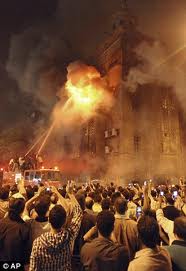
Let us be done with dead religion, and empty traditional institutionalism. Let us also be done with hatred, bitterness, and selfish ambition. Instead of burning down the house, let us understand that we all are, “as living stones,  being built up as a spiritual house for a holy priesthood, to offer up spiritual sacrifices acceptable to God through Jesus Christ.”

Slow Fade

“Now Solomon brought the daughter of Pharaoh up from the City of David to the house he had built for her, for he said, “My wife shall not dwell in the house of David king of Israel, because the places to which the ark of the Lord has come are holy.” (II Chronicles 8:11)

Of all the characters in the bible, I find Solomon to be one of the most tragic. Here was a man described as being the richest and wisest king who ever lived. He had it all, did it all, and knew it all. He is the one who built the awesome temple of the Lord that David had first conceived of. He was the man! Good-looking, rich, wise, and a servant of the Lord to boot; Solomon began his rule in glorious splendor. However, we can see in the passage above that the seeds for his downfall were planted early on.

Reading II Chronicles 8 we find that Solomon was keeping the Law, and had instituted his father David’s Levitical revisions regarding worship, but was seemingly able to compartmentalize his life. Apparently Solomon knew that marrying Pharaoh’s daughter was not right. He obviously recognized the fact that his new bride did not serve the God of Israel, or else why would he refuse her living in a holy place? Yet we find that he married her any way, and built a palace to keep her comfortable and near to him. As we read the Bible, we learn that Solomon took many wives and they eventually drew his heart away from the Lord. I believe his slow fade started right there, with his Egyptian bride. And you know what? We do the same thing.

So often we pride ourselves in the fact that we are real Christians. Not only do we endeavor to adhere to true Biblical orthodoxy, but we know how to worship and praise the Lord with feeling as well. We are the real deal! Nevertheless, off to the side, where it really doesn’t interfere with our relationship with Jesus, we have built a place for our little pet sin. Oh, it’s not causing problems right now; we still worship the Lord, but it’s there all the same. Like Solomon, we may have planted the seeds for our own downfall.

Perhaps that’s why the writer of the book of Hebrews encourages us to “lay aside every weight, and sin which clings so closely, and let us run with endurance the race that is set before us.” We compartmentalize our lives, thinking that, “Okay, over here is my relationship with God and over there is the rest of my life. I know maybe this thing is not really the thing to do, but it’s not causing any real problems. Everything’s cool.” I wonder if perhaps Solomon thought the same thing. We go to church, we preach truth, we dance, we shout, we prophesy, and speak in tongues; but is there a compartment in our heart where we allow our pet sin to live?

“Search me, O God, and know my heart: try me, and know my thoughts, see if there is any wicked way in me, and lead me in the way everlasting.”

The Heart of Ministry

I remember not too long ago I was reading in the book of II Corinthians, and I came to the part in chapter four where Paul said, “…always carrying about in the body the dying of Jesus, so that the life of Jesus also may be manifested in our body. For we who live are constantly being delivered over to death for Jesus’ sake, so that the life of Jesus also may be manifested in our mortal flesh. So death works in us, but life in you.” After reading these words, I thought to myself, “Now there’s the heart of ministry.”

There is much talk today concerning the validity of the pastoral ministry model and the need to employ the five-fold ministry paradigm found in Ephesians 4, but I don’t think the answer is quite that simple. I think we have lost the true heart of ministry all together. We’ve made ministry all about the minister. Ephesians 4 tells us that ministers are given to the body of Christ for the equipping of the saints, and the building up of the body of Christ.  Our churches abound with self proclaimed super-prophets, apostolic rulers, and double portion Davidic worship leaders who have made it all about them. We don’t need superstars; we need servants.

The body of Christ needs ministers who are experiencing the fellowship of his sufferings, manifesting the dying of Jesus in their bodies, those who are willing to become of no reputation, and give themselves for the life of body of Christ. Ministers are not called to be movie star, super-hero, peddlers of the gospel, but slaves of their Master Jesus who emptied himself, taking the form of a servant. The true heart of ministry says, “I will gladly be poured out and used up that I might help my brother’s and sisters mature in Christ.” The prophet, apostle, evangelist, pastor, and teacher are called to build ministers not ministries.

I Corinthians 4:9-13 puts it like this,  “For it seems to me that God has put us apostles on display at the end of the procession, like those condemned to die in the arena. We have been made a spectacle to the whole universe, to angels as well as to human beings. We are fools for Christ, but you are so wise in Christ! We are weak, but you are strong! You are honored, we are dishonored! To this very hour we go hungry and thirsty, we are in rags, we are brutally treated, we are homeless. We work hard with our own hands. When we are cursed, we bless; when we are persecuted, we endure it; when we are slandered, we answer kindly. We have become the scum of the earth, the garbage of the world—right up to this moment.”  Let me ask you, does that sound like any ministers you know? Perhaps the body of Christ would experience more of the power of Christ’s resurrection if its ministers would participate in the fellowship of His sufferings.

I’ll sum it up by simply saying that if you want to see the heart of ministry, just look at the cross.

The Fellowship Of The King


“God is faithful, through whom you were called into fellowship with His Son, Jesus Christ our Lord.” (I Corinthians 1:9)

The word fellowship denotes intimacy, communion, reciprocation, community, relationship, etc… How wonderful it is that we have been called into fellowship with Jesus. For too many who profess faith, Jesus is simply a historical character in a book. They know about him, but don’t really know him. So many are trying their best to be good, stop sinning, and live like a good Christian. All the while they are frustrated, close to despair, and on the verge of giving up. All too often we have opted for a set of rules and empty religious rituals instead of fellowship with Jesus. Being good gets old, and if you’re like me; you’ll break the rules. Thank God, we can have true intimacy with a real, living Savior. We are called to fellowship!!

We are called to hear his voice. We can know his touch. We can be transformed by his Spirit. We can KNOW HIM!! We’ve all heard the old saying, “It’s not what you know, but who you know.” Well, in this case, it’s absolutely true.  And the cool thing is, he wants us to know him!! He has removed everything that would separate us from himself by the blood of his cross. Why has he done this? He wants us to have a real relationship with him. This brings him glory.

It has been said that the reason we exist is to glorify God, and enjoy him. How do we glorify him? How do we enjoy him? It is by the fellowship we have with Jesus. Didn’t Jesus say that we are to abide in him like branches in a vine? Didn’t he say that this fellowship would produce fruit that glorified the Father?  You can read all about someone, you can know their bio inside and out, but until you spend time with them; you don’t really know them. You are called by God to have intimate communion with Jesus. Let me put it this way, fellowship with Jesus is eternal life.

Moved By The Music

(We have covered a lot of ground in our discussion about God Music. It’s getting to the point where it’s kind of impractical to list all of our previous observations at the beginning of each new post, so, I invite you to go back and check out the previous articles entitled “Talk About…God Music”). We all know that music can move you. There is something within the chords and rhythms that can actually produce an affect upon people. Many within the church insist that such “musical manipulation” has no place within the worship experience as it is worldly and/or demonic. Again, as we have in our previous discussions, we want to know what the Bible says about this. I can’t think of a better place to go than II Kings 3: 14-16.

“And Elisha said, ‘As the Lord of hosts lives, before whom I stand, were it not that I have regard for Jehoshaphat the king of Judah, I would neither look at you nor see you. But now bring me a musician.’ And when the musician played, the hand of the Lord came upon him. And he said…”

First, let’s provide a little context. Jehoram, king of Israel, and Jehoshaphat, king of Judah, had gone to Elisha the prophet to inquire of the Lord. They were preparing for battle and needed God’s word concerning the situation. Elisha had no use for Jehoram because of his idolatrous ways, but he had respect for Jehoshaphat, and agreed to meet with them.

We are told that Elisha asked for a musician to be brought in. It is obvious that Elisha sought to use the music as a tool through which he would more readily receive from the Lord. Elisha purposefully employed music to “manipulate” his own disposition. His apparent motive was more than a desire for an emotional release; he wanted to hear from God. (Interestingly enough, if you remember, we learned that when David instituted the Levitical ministry of music, it was looked upon as a form of prophecy.) There is so much that could be inferred from Elisha’s actions, but I want to stick with what the Bible makes plain. Elisha used music to purposefully create an environment which would assist him in receiving from the Lord.

The musician is unnamed. Obviously he was skilled and anointed of God; however, we don’t know who he is, and we never hear from him again. He apparently didn’t start a traveling “Prophecy Mantle Impartation Tour” throughout the kingdom. He was used of God, and then disappears into the pages of antiquity. One thing to note is that it was Elisha that purposefully utilized the musician and his gifts, not the other way around. So often, within our contexts, the musician is asked/required to get the people “in the mood” to encounter God. Elisha’s heart was already going after the Lord; the ministry of music only aided him in his pursuit. I think we need to really consider this point. God Music doesn’t seem to be intended to manipulate people into encountering God. It is for people who already desire Him.

Next, we find that the hand of the Lord came upon Elisha when the musician played. Elisha’s heart and the God Music were both factors in this God encounter. The Lord gave Elisha the words to speak to the kings, and His name was glorified.

In II Kings 3, the Bible gives us a wonderful example of the relationship between music and worship. Our hearts must be inclined towards the Lord with a desire to encounter the living God. Only then can God Music be a means by which His name is glorified as the hand of the Lord comes upon us.

Correction of Inaccurate Statement in Recent Post

In a recent NLI post entitled, “Talk About… God Music: The Levitical Band,” it read, “We are not told how David understood that he was to make this addition to the priestly role. The Bible only shows us that apparently, with God’s blessing, David introduced music/singing as a priestly responsibility in the worship of Yahweh.” This is incorrect.

II Chronicles 29: 25, 26 tells us that it was the Lord himself who instructed David to make these priestly revisions. “…stationed the Levites in the temple of the Lord with cymbals, harps and lyres in the way prescribed by David and Gad the king’s seer and Nathan the prophet; this was commanded by the Lord through his prophets. So the Levites stood ready with David’s instruments, and the priests with their trumpets.”

This serves to lend further credence as to the important relationship of music/singing and the worship of God!


Talk About…God Music: The Levitical Band

Recently, we have been talking about God Music. We have sought to explore the Bible and let it speak to us concerning the relationship between music/singing and worship. One of the hardest things for any of us to do is set aside our presuppositions and allow the Bible to simply speak for itself; nevertheless, we are prayerfully attempting to do exactly that as we consider God Music. We all have personal tastes, likes, and dislikes when it comes to music. Various people groups and cultures differ greatly in how they sing. Our goal is to learn what the Bible has to say about how God’s people are to employ music/singing in worship. On our way, we have observed the following:

1) Worship (including singing, music, and dancing) is a natural response to salvation.

2) Worship (signing) is a natural response to God’s provision.

3) Worship is not a spectator sport.

4) Worship (and the music that accompanies it) is to be 100% God centered.

5) Musical style is not the defining element of authentic worship. The same style of music can be used in both the true, spiritual worship of God, and idolatrous abandon. It is the Object of worship and the disposition of the heart that makes God music.

6) Worship can include singing about the very thing God has provided.

7) Worship (singing) can be an encouragement to God’s people along with being a song to God himself.

8) God himself wrote a song, and commanded Israel to learn it.

10) Singing/Music, in the context of God’s people, may sometimes involve instances where some sing and others listen. (In such cases, the song is still 100% God centered.)

11) God Music can include mention of the people he uses to accomplish his mighty deeds.

12) There can be elements of rebuke in God Music.

Now we come to the period of time when King David ruled Israel, and we find him introducing music/singing as an integral, continuous aspect of worship. We have discovered that the Bible presents music as always being part of worship. However, under Moses, music was not formally set up as a regular duty of the priests. Now, under David, music/ singing became a distinct Levitical function. II Chronicles 29: 25, 26 tells us that it was the Lord himself who instructed David to make these priestly revisions. “…stationed the Levites in the temple of the Lord with cymbals, harps and lyres in the way prescribed by David and Gad the king’s seer and Nathan the prophet; this was commanded by the Lord through his prophets. So the Levites stood ready with David’s instruments, and the priests with their trumpets.”

The Bible says the following:

“David… set apart some of the sons of Asaph, Heman and Jeduthun for the ministry of prophesying, accompanied by harps, lyres and cymbals. (1 Chron.25:1)

“All these men were under the supervision of their father for the music of the temple of the Lord, with cymbals, lyres and harps, for the ministry at the house of God.  Along with their relatives—all of them trained and skilled in music for the Lord—they numbered 288.” (1 Chron. 25:6, 7)

“David and all Israel were celebrating with all their might before the Lord, with castanets,harps, lyres, timbrels, sistrums and cymbals.” (2 Samuel 6:5)

“David told the leaders of the Levites to appoint their fellow Levites as musicians to make a joyful sound with musical instruments: lyres, harps and cymbals.” 1 Chron. 15:16)

He appointed some of the Levites to minister before the ark of the Lord, to extol, thank, and praise the Lord, the God of Israel: Asaph was the chief, and next to him in rank were Zechariah, then Jaaziel, Shemiramoth, Jehiel, Mattithiah, Eliab, Benaiah, Obed-Edom and Jeiel. They were to play the lyres and harps, Asaph was to sound the cymbals, and Benaiah and Jahaziel the priests were to blow the trumpets regularly before the ark of the covenant of God.” (1 Chron. 16: 4-6)

I think it’s obvious from these verses that music/singing became an integral part of the people’s worship when David came to power. We can also observe a few things in these passages that I think are relevant for application to us today.

1) God Music is intended to glorify God. It is ministry to the Lord.

2) Music/singing was a priestly function. Under David, not only were priests responsible for sacrifice, and all the things we are familiar with that God told Moses to institute, certain ones were now set apart for musical worship before the Lord as well.

3) The music, along with the instruments used, was indigenous to the culture of the time. It appears that no instrument was “off limits.” They used what they had to worship the Lord. They wrote the songs, and they employed familiar instruments in their worship.

4) The musicians/singers were skillful. They were taught and instructed.

5) This worship was looked upon as prophesying.

6) This music was not to entertain people; it was to worship the Lord. Interestingly enough, it would appear that this music/singing was something that continuously went on before the Lord. The Levites ministered before the Lord even after the people had gone home. The music was not solely intended to enable people to “get their praise on.” The music/singing continued in the people’s absence.

It would appear that not only is God Music a natural part of our worship of God, but it is also a priestly function.  We will see, as we later move into the New Testament, that singing and making melody is to continue as an integral part of our worship experience.

To be continued…

Vessels not Vassals

Christian, do we really think that legislation is the cure for what ails the land? Do we really believe that we can extend love, grace, and mercy to a group of people that for all intents and purposes we are at war with? Do we really think that the kingdom of God is furthered by amendments and laws?  We are called to preach the gospel, not pass laws. Only the Spirit of God can change the hearts of men. We are called to be vessels of God’s spirit, not vassals of the world system.

Perhaps it is easier to take up arms, march out of classes and demonstrate than it is to get on our faces before God and repent of our own sins. Have we forgotten that the same verses of scripture used to condemn the homosexual also include unrighteousness, envy, murder, disobedient to parents, deceit, gossip, strife, malice, unloving, unmerciful, and without understanding in the same list of sins? When is the last time you as a Christian young person disobeyed your parents? Are you a gossip my dear brother? Are you arrogant? Do you lie to your family and friends? Are you envious? Let me ask you; are we to pass laws against these sins as well?

Maybe the answer to what ails the land is congruent with what ails the church. Perhaps we in the church should repent of murdering our babies, cheating on our wives, spending hours looking at porn on the internet, getting high, etc… Maybe then, after we return to the Lord with all our hearts allowing him to cleanse us and continuously fill us with his Spirit, our lives will be a living gospel transforming those around us. Could it be that what the world needs to see is a church arrayed in the beauty of holiness, a church consumed with love for her Lord, a church meting out agape instead of amendments?

Yes Christian, we are called to holiness. We do not condone sin or make excuses for it. But, that’s the conversation that should be happening within the church. Why are we surprised that the world is behaving immorally? They are without Christ, dead in their trespasses and sin, just like we were at one time. That’s what sinners do-sin. Do we honestly think we can legislate a new heart for them? Or, is that really our goal? Could it be that we are so in love with this world’s system, having confused the American Dream with the blessings of God, that we fear the nation’s sin will bring God’s judgment on the land , and we might lose all of our stuff? Spirit of God, search our hearts.

Let’s turn away from of our preoccupations with, “team Zimmerman,” “team Trayvon,” and our hatred for Dan Savage. Let’s come together in prayer and repentance, asking God to give us a hatred for the sin resident in our own lives. It is time for us to repent of our sin, turn away from our dead religion, quit “running to Egypt for help,” and wash our garments. Let us who are called by his name run to the cross, weep and pray between the porch and the altar, turn from our own wickedness, and return to the Lord in truth. For if the righteous are barely saved, what will become of the wicked. Do I hate sin because I am in love with a holy God, or because I am in love with a self-righteous me? Yes friend, judgment is coming, and it begins with God’s house.

C-O-N-spiracy

One of the definitions offered of the word “conspiracy” is, “any concurrence in action; combination in bringing about a given result.” Well, I have come to realize that I am a victim (maybe I should say recipient) of a conspiracy, and I am so glad! I Peter 1: 2a says that we “have been chosen according to the foreknowledge of God the Father, through the sanctifying work of the Spirit, to be obedient to Jesus Christ and sprinkled with his blood…” Hallelujah! God himself “conspired” to bring about my coming to Christ!

So much time and effort has been spent arguing over the sovereignty of God and the freewill of man, and I simply love the way Peter spends no time arguing or trying to explain it. He simply took what we have turned into a point of contention and offered it to his readers as a source of comfort and encouragement. The believers are assured that despite their suffering and persecution, they can take courage in the fact that God himself hand-picked them as his own. This (s)election is like when someone goes to the market and specifically chooses pieces of fruit- hand-picked, on purpose. He was intimately aware of them (and us) before they were even born, and for the glory of his name, chose them as his own. But wait; the plot thickens!

The Holy Spirit “conspired” to bring the believers to that point in life when they would obey Jesus and be cleansed by his blood. The Spirit of God has been actively at work since the day we were born to bring us to Jesus. The fact that we believe, that we have faith, that we even acknowledge God at all is on account of the sanctifying work of God’s Spirit. Not only that, but he now continues to sanctify us, working in us that which pleases the Father, even using the events of our lives (both good and “bad”) to further conform us to the image of the Son.

Here in this one verse, we see the triune God bringing about our salvation. Oh what a holy conspiracy! Now let’s think about what this means for a moment. If God knew us before we were ever born, if he personally chose us for himself, if the Spirit brought us to the point of obedience, and if Jesus cleanses us by his own blood; my friend, we can persevere in this life. Will not he who brought about our salvation keep us, and present us holy and blameless before him in love? You betcha!!

It may be rough right now. You may be suffering unjustly. There’s no telling what kind of trials you are experiencing, but can I tell you something? God personally selected you for himself, and he will keep you no matter what comes your way.

Talk About…God Music: The First Duet

We are continuing our look into music/singing & worship, i.e. God Music. We are attempting to honestly set aside our presuppositions, and see what the Bible has to say about this topic. We have observed the following:

1) Worship (including singing, music, and dancing) is a natural response to salvation.

2) Worship (signing) is a natural response to God’s provision.

3) Worship is not a spectator sport.

4) Worship (and the music that accompanies it) is to be 100% God centered.

5) Musical style is not the defining element of authentic worship. The same style of music can be used in both the true, spiritual worship of God, and idolatrous abandon. It is the Object of worship and the disposition of the heart that makes God music.

6) Worship can include singing about the very thing God has provided.

7) Worship (singing) can be an encouragement to God’s people along with being a song to God himself.

8) God himself wrote a song, and commanded Israel to learn it.

I suppose the next place to look is at the song of Deborah and Barak found in Judges 5. The period of the Judges, as you recall, was a time in which the people of God were all doing their own thing- whatever seemed right in their own eyes. However, there were times of great deliverance and revival. Singing/music continued to be a part of the worship experience.

In Judges 4, God had wrought a great deliverance through Deborah and Barak (as well as Jael, the wife of Heber the Kenite). Then, in Judges 5:1, the Bible says, “On that day Deborah and Barak son of Abinoam sang this song…” Here is an overt mention of what we would call today a “duet.” All of the other passages we have studied have more or less shown that worship was corporate, involving everyone, or at least the majority of the people. Now, we find Deborah and Barak apparently singing while the others listened.

“Listen, you kings!
Pay attention, you mighty rulers!
For I will sing to the Lord.  I will make music (ESV says, “I will make melody…”) to the Lord, the God of Israel.” (Judges 5:3 NLT)

We find that Deborah and Barak sang a song of praise to God, employing music that would have obviously been indigenous to their culture. The song they sang was about the way God had saved them, the people through whom he had worked, and even contains what may be taken as rebuke to those who had not participated in the battle. In this song, the people were also encouraged to tell of the things God had done.

Obviously there is much that could be gleaned from this passage of scripture, but what can we learn from this incident that speaks directly to the subject at hand? How about the following:

1) Singing/Music, in the context of God’s people, may sometimes involve instances where some sing and others listen.

2) In such cases, the song is still 100% God centered.

3) God Music can include mention of the people he uses to accomplish his mighty deeds.

4) There can be elements of rebuke in God Music.

To be continued…