Power!!

Jesus said that we would receive power when the Holy Spirit indwells us, and that we would be his witnesses. I began to think of this verse in a little different way the other day. Normally, maybe it’s just me, but; when I think of that verse (Acts 1:8), I think of the miracles the Apostles did in the book of Acts. Maybe I’m just a product of the times in that so much is preached now a days concerning how we are to be doing the miraculous, walking in the prophetic, conquering this, and subduing that. Don’t get me wrong; I understand, for the most part, what folks are trying to say. Lately though, I’ve been thinking of “witness power” a little differently.

As we walk in the Spirit, as Jesus is saving us, healing us and giving us his love, as we experience the love and forgiveness of God and the powers of the age to come; it is truly mind blowing! How do you adequately describe the holiness of God, the unconditional love, the peace of God, the way he can take the mess I’ve made of my life and turn it into something that will glorify his wonderful name? You’ve got to have the power of the Spirit! Paul told the Corinthians that  “we do not use words that come from human wisdom. Instead, we speak words given to us by the Spirit, using the Spirit’s words to explain spiritual truths. (I Corinthians 2:13)

I can’t even begin to describe the awesomeness of God without the power of his precious Spirit. As we walk with him, as we come together in holy fellowship, as we wait on him, as we minister to him in those “secret times” of loving intimacy, prayerfully seeking his face, meditating on his words; it is in those quiet places of surrender, being filled freshly with his Spirit  that we are equipped to show forth his glory.

My prayer today is, “Lord, fill me with your Spirit that I may have the ability to put into words just how awesome you really are!”

Trim The Fat

Many medical authorities are asserting that Americans have a definite obesity problem. We Americans are quite simply among the most overweight people groups on the planet. Along with this excessive weight comes increased risk of disease. Diabetes, hypertension, and cancer are just a few diseases that may be triggered by “a bulging belly.” I think that perhaps we who make up the “American Church” also suffer from an obesity problem and that rampant false doctrines, heretical teachings, immorality within the leadership, etc… are the diseases this obesity has produced and perpetuated. 

Here in America we are inundated with Christian programming, Christian radio, Christian Bookstores, mega-churches, how to do this & how to be that instructional teachings, and all of this has served to produce an overweight, self-indulgent body more concerned with her own glory and beauty than that of the Lord who purchased her with His own blood. We have fed to the point that we have come to resemble the “fat cows of Bashan” spoken of by the prophet Amos. 

All of this “feeding” has produced a people who worship the way God makes us feel instead of worshiping God Himself. We scramble to and fro to find the preacher with the “fresh word”, the worship leader with the “heavy anointing”, and we feed upon that which only makes us fat and diseased. We have ceased to eat the “true Bread which came down from heaven” and crave the “raisin cakes” of our own idolatry instead. Sure, we are to come together, be built up, be encouraged in the Lord, exercise our gifts for the building up of the church; but, that’s not where it ends.

The Church is not designed to be a “social club” comprised of people who have received their “get out of hell free cards” and now, while waiting to be raptured out of here, indulge themselves in an endless feeding frenzy. No, we are called to the work of ministry. There is a world filled with people who need to hear of the love of God that is only found in Jesus. There is a hurt and desperate world (not to mention those who fill the pews) waiting for someone to minister to them. Can we not push ourselves away from the “table” long enough to feed someone else?

Just like the physical body has to have exercise and proper diet to combat obesity, the church must also utilize these elements in a spiritual fashion. Hebrews 12 tells us, “let us also lay aside every encumbrance and the sin which so easily entangles us, and let us run with endurance the race that is set before us…” Perhaps the sin which so easily entangles the American church is the sin of gluttony, and this constant feeding has produced an over weight body wrought with disease. 

Let us pray that the Lord will grant us mercy, that we may again fix our eyes solely upon Him, that we may be filled “with the knowledge of His will in all spiritual wisdom and understanding, so that you will walk in a manner worthy of the Lord, to please Him in all respects, bearing fruit [instead of fat] in every good work and increasing in the knowledge of God; strengthened with all power, according to His glorious might, for the attaining of all steadfastness and patience; joyously giving thanks to the Father, who has qualified us to share in the inheritance of the saints in Light.” 

“This Aint No One Man Show!”

Recently we have been talking about how everyone who is a disciple of Jesus is called to do the work of ministry. We have been trying to learn what we can about ministry from the story of feeding the 5,000 found in John 6. We have discussed how Jesus had brought the disciples into what appeared to be an impossible situation, but in reality He already knew what He was going to do. The disciples saw the great need and figured the best thing to do was send everybody away to fend for themselves, but;  Jesus being the ultimate shepherd (pastor), saw this as an opportunity to equip, teach, and meet the needs of those who had come to hear Him speak.

Someone once said, “You’d be surprised what can be accomplished when you don’t care who gets the credit.” I think another thing to be learned  from the  story in John 6 is that sometimes in ministry Jesus may use you to be a coordinator. You may not be the one who directly meets the need, but you may be one who the Spirit of God uses to coordinate. Like the disciples you may think you have nothing to give; but, God has a plan. That day on the hillside the disciples figured that perhaps the best thing to do would be to send the folks away. They saw the multitude and didn’t see any way they could meet the need. How many of us have avoided ministry because we didn’t think we could be used of God? We saw our own lack and thought, “What can I do?”  Perhaps, we need to understand that true  ministry is not a “one man show.” Real ministry involves the whole “Body.” We can see this in the story of the feeding of the 5,000.

Andrew (one of the disciples) becomes aware of a boy that has brought a packed a lunch; but doubts that it could accomplish anything. “Lord the need is so great, what will this little bit accomplish?” How many times have you felt like sharing or giving or saying something, but felt like it wouldn’t amount to anything? But what did Jesus say? He said, “Bring the lunch to me.”

Once, as I was reading this story, I began to wonder about the little boy with the lunch. Was he really the only one who had sense enough to bring food that day or was he the only one who was willing to surrender his? Sometimes we are so concerened with our growth, our relationship with the Lord, etc… that  we forget that its not all about us. In the Old Testament , when the land was being alloted and the 2½ tribes opted to stay on the east side of the Jordan, they still had to send their warriors to help their brothers  who had yet to obtain their inheritance. Are you so focused on you and yours that you have forgotten that there are brothers and sisters in Christ (not to mention unbelievers) who need you to minister to them?

To this day the little boy with the lunch remains nameless and faceless. We don’t know who he was, his name, or anything. He’s the kid with the food. How many of us would have been like,  “Ah, this little bit wont do any good” or “I’m keeping my stuff they should’ve known better” or “I can’t believe Jesus didn’t even mention my name; they should’ve at least named the grassy slope after me.” Can you see how cool it is that Andrew became aware of the boy, the boy was willing to give up his lunch, and Jesus was the one who performed the miracle and brought glory to God. That’s how true ministry is supposed to work. We all just come to Jesus and say, “Here Lord, use me how ever you’d like to.”

Jesus used a little boy to give the disciples something to distribute among the people. It all came from Jesus’ hand; that’s how true ministry works. Maybe you’re the little boy, nameless & faceless, or; maybe you’re like the disciples, seen and used to distribute the food- it doesn’t matter. It’s all from Jesus and for His glory. Will you come and give yourself and what you have to Him. Will accept your role whether it be known or unknown? Will you come and surrender yourselves and your gifts that He may bless? Will you allow Him to break it up and distribute it as He sees fit?

Service is not something that a lesser person does to someone greater; no, it is the lifestyle of a disciple. You are called to minister, you are called to serve. That pride and selfishness which is resident in so many of us must be broken so that what God has given us may be used to bring others to Christ. Our American “I’m supposed to be a celebrity” mentality has to be broken. You are called to ministry beloved by the one who though He was God, emptied Himself and took the form of a servant.

“You give them something to eat.”

If you read Who, me? (Equipped for Ministry) you remember I was talking about how all who are in Christ are called to ministry and that it is not just the job of the “professionals.” According to Ephesians 4 it is the job of the “professionals” to equip the saints so that they themselves can do the work of ministry. The cool thing is, Jesus already knows how he wants to use you. He knows what He wants to accomplish through you. Let’s check out John 6.

“Then Jesus climbed a hill and sat down with his disciples around him. (It was nearly time for the Jewish Passover celebration.) Jesus soon saw a huge crowd of people coming to look for him. Turning to Philip, he asked, ‘Where can we buy bread to feed all these people?’ He was testing Philip, for he already knew what he was going to do. Philip replied, ‘Even if we worked for months, we wouldn’t have enough money to feed them!’ Then Andrew, Simon Peter’s brother, spoke up. ‘There’s a young boy here with five barley loaves and two fish. But what good is that with this huge crowd?’ ‘Tell everyone to sit down,’ Jesus said.” (John 6: 3-10)

 There’s a lot we can learn from this story, but for now; let’s just look at this one aspect : Here, in John 6, Jesus knew what He was going to do. He is asking Phillip how they would feed the people, but He already knew what He was going to do. Jesus may bring you into a situation where you cannot possibly meet the need in and of yourself. Like the disciples you may look out and say, “Lord, we need to send these folks away so they can get something to eat…” and He replies, “No, you feed them.” You look around and it seems impossible, the need is to great, but He knows what he’s going to do. He is teaching us that it is through our relationship with him that we will be used to meet the need of those he brings into our lives.

You see part of equipping Phillip,the rest of the disciples, and you and me for that matter is deliberately putting us in a situation in which we are insufficient within ourselves to minister.  We begin to learn to trust in Jesus’ ability, in his sufficiency. We come to the place when we realize that it is only that which flows out of our union with Christ that will glorify God and meet the need. We look around and see so much hurt, so much pain, so much need, and we say, “Lord, help them. I can’t do anything.” BUT HE KNOWS WHAT HE IS GOING TO DO!!  And he wants to use you!

As it is with all true ministry,this feeding of the 5,000 would glorify Jesus and show the crowd who he was, and; that’s what you are called to do- show those he brings to you who He is. You may not be called to stand behind a pulpit or travel to Haiti or write books or make cds, but; you are most definitely called to show others who Jesus is. The Bible tells us in Ephesians 2:10 that “you are God’s workmanship created in Christ Jesus for good works that God prepared beforehand for you to walk in.”

Yes my friend, if you are a disciple of Jesus; you are called to do ministry. But, don’t you worry; the Lord is in control and He already knows what He wants to do through you.  Oh, I almost forgot; don’t be surprised if it seems impossible.

Who,me? (Equipped for Ministry)

When you think of ministry what comes to mind? For so many of us, when we think of ministry we think of Billy Graham, pastors we have seen on TV, or perhaps our local pastor, but; did you know that if you are a Christian, you are called to ministry? “Who, me?” Yeah, you! Those who occupy the pews more often than not have the idea that it’s the “professional” minister who is called to do ministry, the big named evangelist who is called to reach the masses; it’s the anointed worship leader who will do the work of ministry.   So many sit comfortably in their pews under the misconception that all they are called to is to love the Lord, come to church regularly and “be fed.”

You hear people say, “I’m just not getting fed.” Why not? You have the same Holy Spirit, the same Jesus. Yes, the “five-fold office gifts” (please, let’s not argue over semantics) are to feed and teach to some degree, but; you the believer are to abide in Christ, sit at His feet and hear His voice. John tells his hearers in his first epistle that the “anointing” you have received teaches you. You know, when all we do is continually eat we can become obese and doctors tell us that obesity is a primary cause of all kinds of diseases. Maybe that’s why we have so much sickness in the church, because all we’re doing is gorging ourselves and not doing ministry- I’d better stop.

We find that in Ephesians 4 the bible tells us that Jesus gave gifts to the church: Apostles, Prophets, Evangelists, Pastors and Teachers for the equipping of the saints (that’s you if you are in Christ) for the work of the ministry (your Bible may say work of service or something similar). So really, the job of the “vocational minister” is to equip the saints do ministry. We need to move away from this “clergy/laity mentality” and understand that all who are in Christ are called to do the work of ministry. Ministry, is something all believers are to do.

Okay, so what does it mean to be equipped ?  Well if you study the word translated equip you find that the word refers to that which has been restored to its original condition, is being made fit or being made complete. The root word was used as a medical term used for setting bones! Secular Greek also used it to refer to the furnishing a house. Paul’s use in the context of the Body, the Church, pictures the complete furnishing of the believer so that he/she might be made ready to fulfill their purpose in the body of Christ where they have been placed by God’s Spirit. This equipping denotes the “net-mending” process the fishermen would utilize, equipping the net to catch the fish. The Greek word denotes not so much an adding something that is lacking, but rather a straightening out. We have handed all ministry over to the “professionals” when in reality it is the job of the “professional” to equip the saints to do ministry themselves!

My friend there are people who will listen to you that will never listen to Billy Graham. There are people who need to hear what God has done in your life. There are people who may never, ever be touched by the love of Jesus if they don’t hear about it from you. Let me leave you with this: “…you are a chosen people. You are royal priests,a holy nation, God’s very own possession. As a result, you can show others the goodness of God, for he called you out of the darkness into his wonderful light.”


House on the Risen Son (Doing)

“So why do you keep calling me ‘Lord, Lord!’ when you don’t do what I say? I will show you what it’s like when someone comes to me, listens to my teaching, and then follows it. It is like a person building a house who digs deep and lays the foundation on solid rock. When the flood waters rise and break against that house, it stands firm because it is well built.  But anyone who hears and doesn’t obey is like a person who builds a house without a foundation. When the floods sweep down against that house, it will collapse into a heap of ruins.” (Luke 6:46-49)

In our previous segments we’ve talked about coming to Jesus. We’ve looked at how he desires us to be hearing him speak. Now, we want to look at a third aspect of  the wise builder: doing. So many today shout “legalism” or “Pharisee” anytime they are told they must obey or do something. We are sometimes sold an imitation gospel here in the USA, one that says all you have to do is come, ask Jesus in your heart, and then; you’ll prosper, achieve your divine destiny, etc… However, Jesus assures us that unless we do something about what we hear as we are coming to him, we are building on unstable ground.

Here, in Luke 6 this doing, the third leg on our tripod, has the same connotations as coming and hearing- it’s a continuous doing.  I want to keep repeating this: coming, hearing, and doing are continuous, a right now ongoing thing. Jesus said his disciples are not just the ones who hear his word but do it. It is those who are coming, are hearing, and finally, are doing that are his disciples. Remember he asked, “Why do you call me Lord and don’t obey me?” You see, when you study the Bible you find out that “being” and “doing” are always linked. If you really are what you say you are you will do his word and not just hear it. Jesus says he who keeps my word, continues in my word, who obeys and does my word; this one is my disciple. None of us are perfect my brothers & sisters, but the New Testament clearly teaches that a disciple is one who is doing the word.

 James 1:22 tells us that the  one who hears and does not do is deceived. Remember how I said that the Greek, here in our Luke 6 text, showed that this coming, hearing, and doing, was something we did ourselves, for ourselves? Well this being deceived is the same type of word. The one who is merely going to the Bible, hearing the words of the Lord, and not doing them, are right now, present tense, walking in deception which they have brought upon themselves. You know, some people enjoy hearing the word of the Lord. Some people enjoy being convicted. I think of Herod who was moved when he would listen to John the Baptist  preach, but; he never did anything about it!!  I want to drive this home: Jesus is telling us that as disciples we must be coming to Him for the word, continuously hearing His word, and continuously doing His word. Pastor Dennis Hall mentions that Christ, while on earth, enjoyed constant communion with the Father as he continuously sought him in times of isolated intimacy. Jesus continuously came to the Father, heard him speak, and then did what he said. And so it is with us- You can’t only come, you have to hear. You can’t only hear you have to do. (One thing we need to remember is that unless this doing flows out of  the intimacy of coming to him we can easily wind up wind up like the Pharisees.)

Let’s come to Jesus and put into practice the things we hear from him. As we do, we will dig deep and build our house on the risen Son of God.

“You say you want a revolution, well you know…”

In the early part of this past summer I posted  a note on my personal Face Book  page asking the question, “Was Jesus a revolutionary?” Since that time, NLI Ministries has been launched, and I wanted to make this “article” available to those who regularly interact with NLI  but do not know me personally. During the seven months since I originally posted this article there has been increased interaction between ecclesiastical and political groups, Christians and secularists alike are joining together calling for revolution. Everywhere you turn, Christians are starting movements or “yoking up” with secular movements because after all, Jesus was a revolutionary.  What is the definition of revolution? And, after examining the definition of revolution, can we honestly assert that Jesus was a revolutionary?

Here are the definitions of revolution:

1 a: (1): the action by a celestial body of going round in an orbit or elliptical course; also: apparent movement of such a body round the earth (2): the time taken by a celestial body to make a complete round in its orbit (3): the rotation of a celestial body on its axis

b: completion of a course (as of years); also: the period made by the regular succession of a measure of time or by a succession of similar events

c (1): a progressive motion of a body around an axis so that any line of the body parallel to the axis returns to its initial position while remaining parallel to the axis in transit and usually at a constant distance from it (2): motion of any figure about a center or axis revolution of a right triangle about one of its legs generates a cone> (3): rotation 1b

2 a : a sudden, radical, or complete change

b: a fundamental change in political organization; especially: the overthrow or renunciation of one government or ruler and the substitution of another by the governed

c : activity or movement designed to effect fundamental changes in the socioeconomic situation

d: a fundamental change in the way of thinking about or visualizing something: a change of paradigm <the Copernican=””>revolution></the>

e: a changeover in use or preference especially in technology <the computer=””>revolution> <the foreign=”” car=””>revolution></the></the>

While I tend to regard 1b & c1 as possessing a far more interesting application to Jesus, would be revolutionaries tend to hone in on 2: a, b, c, & d.

Perhaps the best way to determine if Jesus was a revolutionary is to consider definition 2: a, b, c, & d, and then decide whether or not these definitions are applicable to Jesus during his earthly ministry.

 2A): a sudden, radical, or complete change-

Did Jesus bring about a sudden radical and complete change? Spiritually speaking, the death of Jesus on the cross did bring about a sudden, radical, and complete change; but, did He bring this kind of revolution in the natural realm? No, and that was part of the reason the Jews did not accept Him as Messiah. The Jewish messianic expectation centered on the concept of the conqueror which would come and “revolutionize” society.  It was hard for them to conceive of the “suffering Servant” and Jesus constantly designated Himself as the “Son of Man” to redirect their messianic paradigm. What of the parable of the leaven and the mustard seed?  The leaven seems like it should have no effect on such a large piece of dough, and the mustard seed is so small. Was Jesus not assuring His followers that although “you may not see it now, this kingdom I have inaugurated will continue to expand and grow?” It appears He was not the “revolutionary” the Jews were expecting.

2B): a fundamental change in political organization; especially: the overthrow or renunciation of one government or ruler and the substitution of another by the governed –

Again, this aspect of revolution must be considered from both a spiritual and natural perspective. On one hand, the Lord did most definitely come to deliver man from the dominion of Satan, sin, and self; but, He left both the religious system of the Jews and the Roman government intact. The Jews expected the messiah to overthrow the oppressive government that ruled them and install them as the chief nation; once more, Jesus was apparently not the “revolutionary” they had in mind. (Remember Barabbas)

2C): activity or movement designed to effect fundamental changes in the socioeconomic situation –

This may be the most controversial aspect of our present discourse. Did Jesus set out to fundamentally change the socioeconomic situation of His day; and if so, should we as Christians endeavor to do the same?  One has only to examine the teachings of Christ to see that He was indeed interested in the poor and the oppressed.

“And the book of the prophet Isaiah was handed to Him. And He opened the book and found the place where it was written, ‘THE SPIRIT OF THE LORD IS UPON ME, BECAUSE HE ANOINTED ME TO PREACH THE GOSPEL TO THE POOR. HE HAS SENT ME TO PROCLAIM RELEASE TO THE CAPTIVES, AND RECOVERY OF SIGHT TO THE BLIND, TO SET FREE THOSE WHO ARE OPPRESSED…’”

If He were speaking in reference to socioeconomic conditions it would appear that our Lord did fail miserably. When He ascended to the Father, He left behind many poor, blind, oppressed people. Jesus even stated, “You will always have the poor with you…” He called the poor and suffering blessed on many occasions. It appears that Jesus viewed socioeconomic factors differently than most of us do.

We tend to think that if we, eliminate poverty, put a Christian in every government office, change all the unjust laws and “revolutionize” the present society we will further the kingdom of God. Jesus knew it was the heart of man that needed to be changed. Poverty, oppression, injustice, etc… are not conditions that will be changed by revolution, rather, it is by the preaching of the gospel and the establishment of the kingdom of God in the hearts of men that will cause men to love one another as they love themselves. Think about it, abortion was illegal for a long time; but, abortions were still being performed. Drugs are illegal; but people still abuse them.

When one examines the life and teachings of Jesus, it is apparent that He sought the change in man’s heart over the change of socioeconomic conditions. When the heart changes, the conditions change.  Revolution?

2D): a fundamental change in the way of thinking about or visualizing something: a change of paradigm <the Copernican=””>revolution> -</the>

In regards to this aspect of revolution, one could contend that Jesus was indeed “revolutionary”. He constantly asserted, “You have heard it said; but I say to you…” He offered to the Jews a new way to see their religious laws. He put forth a new way to see our fellowman. He challenged the concept of “neighbor”. He broke the rules when it came to fraternization with minorities. These are but a few of the ways Jesus challenged the “norm”.

I maintain that while Jesus’ earthly ministry obviously possessed revolutionary characteristics, He was not, by our definition, a revolutionary. He did not seek to destroy the Jewish law; on the contrary, He fulfilled it. He did not seek to overthrow the Roman government; on the contrary, He taught that one should love His enemies. The focus of His ministry was on establishing the rule of God in the hearts of man. It would seem that Jesus viewed the socioeconomic, political landscape as a backdrop against which the light of the life of the kingdom of God would be expressed through the lives of His disciples.

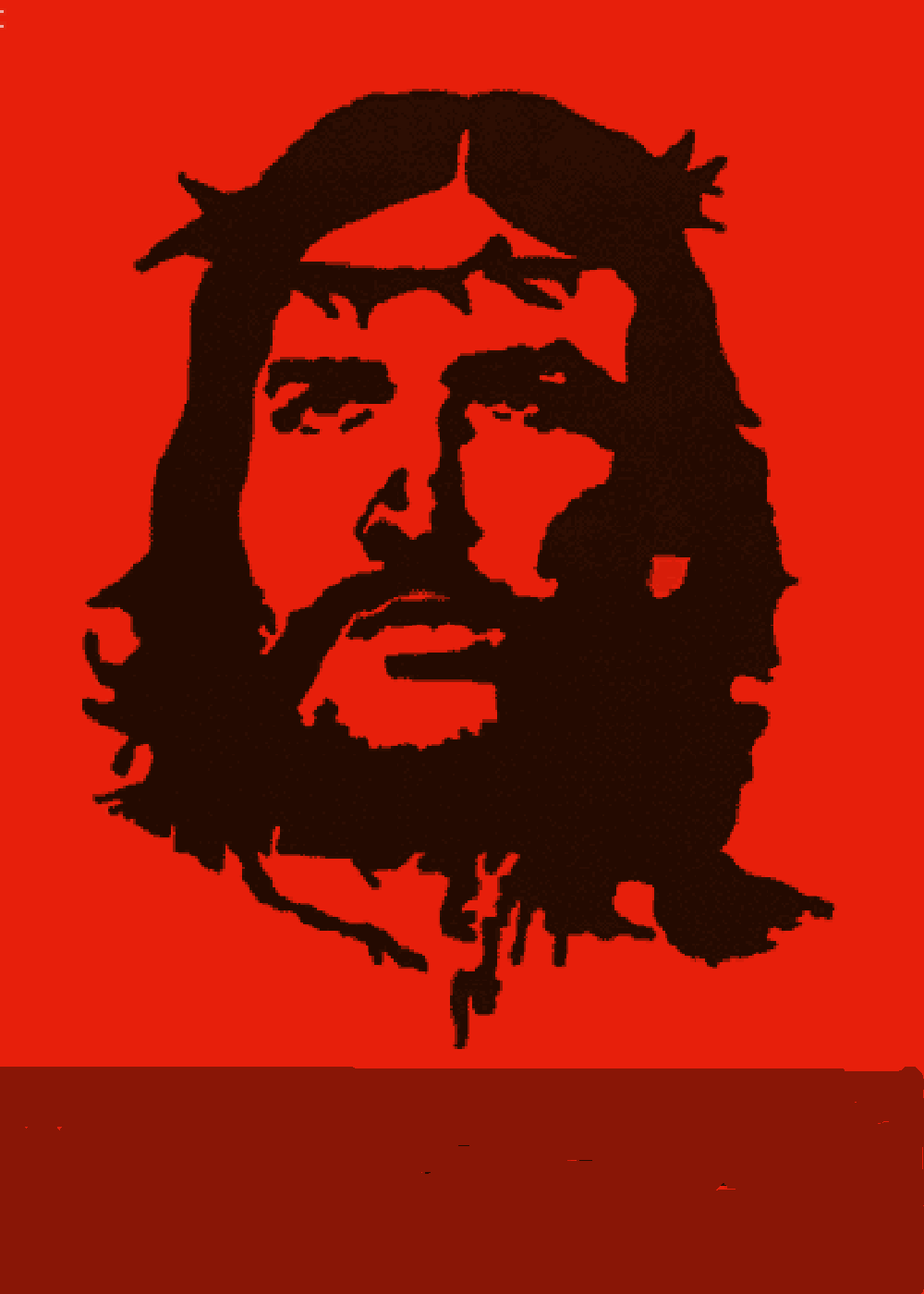
Jesus is not Patrick Henry or Che Guevara, and we are not called to join a “movement”. We are called to the cross, to the preaching of the gospel, and to the laying down of our lives. The Apostle Paul put it this way, “we are afflicted in every way, but not crushed; perplexed, but not despairing; persecuted, but not forsaken; struck down, but not destroyed; always carrying about in the body the dying of Jesus, so that the life of Jesus also may be manifested in our body.  For we who live are constantly being delivered over to death for Jesus’ sake, so that the life of Jesus also may be manifested in our mortal flesh.  So death works in us, but life in you.” (II Corinthians 4:8-12 NASB)

House on the Risen Son (Hearing)

“So why do you keep calling me ‘Lord, Lord!’ when you don’t do what I say? I will show you what it’s like when someone comes to me, listens to my teaching, and then follows it. It is like a person building a house who digs deep and lays the foundation on solid rock. When the flood waters rise and break against that house, it stands firm because it is well built.  But anyone who hears and doesn’t obey is like a person who builds a house without a foundation. When the floods sweep down against that house, it will collapse into a heap of ruins.” (Luke 6:46-49)

The last time we looked at Luke 6 tEditogether we saw that there are three things that really stand out in the story Jesus is telling about house building: Coming, Hearing, and Doing. We have discussed that Jesus says the wise builder is one who continuously comes  to him. Next, we observe that Jesus says the wise builder is the one who is continuously hearing him.

As we are continuously coming to Christ, we will be continuously hearing God speak. Again, the original Greek brings out the fact that it is a continuous hearing that Jesus is speaking of: “Everyone who who is hearing…”

Scripture repeatedly warns against becoming “dull of hearing.” There are so many places in the Bible that we find comments like, “He that hath ears to hear” or “Having ears but not hearing.” How any of us came to Christ after hearing the gospel but have stopped coming to hear from him? When is the last time you heard God speak to your heart? So many say, “Well, God never talks to me, etc…” Well, are you continually going to him in prayer, reading his word, spending time in worship (just you & Jesus),  and in fellowship with your brothers and sisters?  Jesus promised that his sheep would hear his voice, that they would know him, but, as we see in Luke 6; this hearing is linked to a continual coming to Him.

Check out these verses:

Jeremiah. 6:10 “To whom  shall I speak and give warning That they may hear? Behold, their ears  are closed And they cannot listen Behold, the word of the LORD has become a reproach to them; They have no delight in it.”

Zechariah 7:11 “But they refused to pay attention and turned a stubborn shoulder and stopped their ears from hearing.”

As I was thinking about hearing , I read the story of the deaf  gentile man with the speech impediment found in Mark 7:32 . This guy had been brought to Jesus and his friends were asking Jesus to heal him. I am deeply moved by the compassion and tenderness Jesus displayed in his dealing with this man, how he took him off to the side, away from the crowd. As I read,I began to remember all the times I have heard people mock the way deaf people speak and I imagined that people may have indeed mocked this man as well. It occurred to me that perhaps Jesus did not want to subject him to ridicule or embarrassment so he took him off to the side, by himself to minister to him. The deaf man’s speech impediment came as a result of his inability to hear, in many ways; this mirrors what happens to us when we don’t come to Jesus and hear him speak, or when we grow dull of hearing. When we fail to continuously come to Jesus and hear him speak,  when we become deaf to his words, our ability to communicate to others the awesomeness of knowing Jesus is impeded. We are not hearing and we are therefore not able to speak clearly the things the Lord desires for us to share with others. Like the deaf man, we need to come to Jesus, and once we are able to hear, we will be able to tell others of  all that God has done for us.

Jesus said that the wise builder is the one who is coming to him, who is hearing him, and as we shall see next time; the wise builder is one who acts on the words of of the Lord.

House on the Risen Son

By now every one knows about how the “housing bubble” burst here, in America. But what we don’t hear a lot about are the spiritual houses collapsing around us everyday.  Luke 6:46-49 has this to say:

46 So why do you keep calling me ‘Lord, Lord!’ when you don’t do what I say? 47 I will show you what it’s like when someone comes to me, listens to my teaching, and then follows it. 48 It is like a person building a house who digs deep and lays the foundation on solid rock. When the floodwaters rise and break against that house, it stands firm because it is well built. 49 But anyone who hears and doesn’t obey is like a person who builds a house without a foundation. When the floods sweep down against that house, it will collapse into a heap of ruins.

 If we look closely at this passage from Luke, a couple of obvious things stand out: coming, hearing, and doing. I like how the scriptures  point out  the way Jesus would wait upon the Father, continuously seeking Him, and hearing from Him as to what to do and what to say. We find that Jesus said, “I’m never alone because I always do that which pleases the Father.” Jesus continuously came to the Father, he continuously listened to the Father’s words, and finally; he always did what the Father showed him. Jesus’ relationship with the Father had the same characteristics he talks about in our section out of Luke 6. If we are to avoid a housing collapse in our lives we need to understand  what Jesus was talking about in regards to this Coming, Hearing, and Doing. Let’s look first at the Coming.

As most of  you know, our English New Testaments were translated from Greek manuscripts, and sometimes looking at a verse as it is written in the Greek will bring out aspects of the verse we might otherwise miss. In the case of our passages out of Luke 6, the original Greek brings out clearly that the coming to him Jesus has in mind is a continuous coming to him. The Greek reads, πᾶς ὁ ἐρχόμενος πρός με or,  “Everyone who is coming to me” Just as Jesus went continually before the Father, so we must continually come to Christ. So many refer back to the time they came to Christ, “Yeah, 20 years ago I got saved…” But are we coming to him today?  Jesus said that man shall not live by bread alone but by every word that proceeds from the Father. Our relationship with Jesus must be an on going, right now, present tense relationship. Remember during their time in the wilderness, after the Exodus, the children of Israel were to gather fresh manna every morning. In Moses’ tabernacle, fresh bread was placed upon the table of show bread every Sabbath. It was not allowed to get stale. Brothers and sisters our coming to Christ must be continuous. There is fresh bread but we must come!

The Greek also depicts this coming as something that we do. It carries the aspect of the subject (us) doing something intentionally, with his own benefit in mind. (We Americans ought to be good at this: “What am I going to get out of this?”) This is an intentional coming to Christ on our part. So often we think that we are just going to magically grow in Christ through some kind of osmosis, but; Jesus is saying here in Luke 6 that it is you and I who are to come to him on purpose, continually. Let me ask you to think for a moment… What do you continuously run to? We intentionally go to the TV, the computer, our entertainment,  our families, and the list goes on and on, but; do we intentionally turn aside and draw near to hear God speak to us?  We ask God for his grace for this and that, but; what about asking him for the grace to seek his face. Grace is not solely for when we mess up.  Grace is the power of the kingdom! Let’s ask him for the grace to seek his face.

We also need to see here in Luke 6 that Jesus said we are to be continuously coming to HIM, hearing Him, and doing His word. It’s all in Him! So many of us spend our time running here and there, looking for the latest word from this one or that one, and; Jesus wants us to be coming to him, and hearing his words.  Intimacy with Christ is the key thing here. Let me tell you something, “God is not hiding out in the Bible.” Now understand me, the Bible is the inspired word of God profitable for teaching, correction, reproof and training in righteousness, so that you and I can be adequate and equipped for every good work; but the only way we can properly understand this book is through relationship with Christ. This is what Jesus told the Jews in John 5:39, 40, “You search the scriptures but you don’t see that they speak of me, and you are unwilling to come to me that you may have life.” This book speaks of him! The Bible is not intended to be worshiped or as some kind of magic book with spells in it that will magically give us eternal life- No!! This book is to bring us to Jesus. We can read this book every day (the Jews had most of it memorized, and oh yeah, the devil can quote it too), but if we are not continually coming to Christ, they are merely words on a page.

Here is  the best part of all: Even though our passage tells us that our continuous coming to Christ is something we do ourselves, he is the one that makes first contact!  Remember  the story of Mephibosheth in 2 Samuel 9? Remember he was the crippled son of Jonathan who David sought out to show mercy and kindness to? (See our post Mephibosheth Saith)  Like David, your King is seeking you out, he will carry you into his presence himself, and he will make the way. Mephibosheth was not seeking David, David sought him. And Jesus is seeking you!

The first step in building a House on the Risen Son is a continual coming to Jesus!

(Next time we’ll look into the hearing part.)

Postmodern Reflections: Concluding Thoughts

The most obvious  evidence of  the Emergent/Postmodern Movement’s (EPM) heretical nature is the treatment of the Lordship of Christ and the atonement. To the EPM, Jesus is more or less a social activist and the cross is rarely referred to.  The need for forgiveness and freedom from sin is, for the most, part ignored by the EPM, and an emphasis is instead place upon the “work of the Spirit” already present in various cultures and faiths. It is not a relationship with God through faith in Christ that is stressed within the EPM, but rather it is the enlightenment which comes through communal fellowship that appears to be the primary objective. Perhaps an emphasis on the cross and the blood is somewhat offensive to the delicate, sensitive, enlightened minds of the EPM. Perhaps  the cross and the blood have become irrelevant as they maintain that while God has indeed acted uniquely in the person of Christ; he is just as active through the means of other religions and one had better not try and restrict God to one belief system. “One can never tell what God might do.”

It is obvious that many within the body of Christ are aware of the danger of  the EPM and are speaking out against it. The internet is filled with numerous sites dedicated to the exposition of false teachings and it appears that the EPM is at the top of the list. However, I have observed that many so called evangelical sites seem to be adverse to any type of new “preaching method” While  I am adamant in my insistence that the EPM is a major factor in the end time apostasy as told by the apostle Paul, I cannot however take the stance of many that the only way to “have church” is by strict adherence to the “three hymn, three point sermon, and out by twelve o’clock” paradigm, or that strict historical/grammatical interpretation of the Bible is the only legitimate form of hermeneutics. (An interesting study is how the New Testament writers made use of the Old Testament.)

The EPM  is correct in insisting that the world no longer follows a modernity minded motif and sadly many within the body of Christ have refused to acknowledge this fact. While many have stuck their heads in the proverbial hole in the ground, hoping for the good old days to return; what is at stake  are the countless souls that will be lost should the people of God fail to learn from the weaknesses the EPM  heresy has revealed. Michael Andrus claims that heresy (i.e.  EPM)) is a tool God uses to reveal deficiencies within the church, and I am inclined to agree. The church must be willing to utilize tools found within the postmodern culture as instruments of preaching the gospel. To many within the traditional church it seems strange to say that the gospel can be preached through art. But in an age that is increasingly visual and sense oriented, art may be a tool by which the cross of the Lord Jesus is put on display. Concurrent with this visual genre is the utilization of video and other multimedia tools. In the postmodern world, “sermon jams” and gospel oriented videos are an outstanding means by which to communicate the gospel.

While one must be careful to understand that the Bible is not simply a narrative to be interpreted as one filters it through his own cultural context, this writer would agree with the EPM that too often the modern mindset of ecclesiastical institutionalism has restricted biblical interpretation to a form whereby, much like the Pharisees of Jesus’ day, scriptural interpretation is  static and rigid. While comprehension is academically acquired; the heart of the interpreter does no encounter the living Christ scripture is pointing to. To many modernists, the Bible itself has become God. Listening to many “evangelical” preachers one often finds the minister quoting the Bible in a fashion which depicts it as the “end all” instead of the means to the Ends. I  believe that the Bible was provided for man, by God, who watched over and guided its compilation, breathed every word as it was written in its original language, and was given as a means by which to encounter the one true God in the person of Jesus Christ. Unfortunately, while the EPM claims to desire an authentic encounter with Christ, through scripture (even though they can’t be sure who he really is), given their epistemology; one wonders how this could be achieved.

It should be stated that EPM communities vary greatly. While one group may have certain emphases, another is vastly different. One would be hard pressed to say, “This is what EPM churches look like.”  Emergent communities may “shed their skin” and take on a new look as the community feels the need. The differences between an EPM church and the traditional church are a bit more obvious.

Whereas the traditional church has a senior pastor, deacon board, and perhaps elders; the EPM makes every effort to appear leaderless and communal. The traditional church will meet in the traditional church building and be decorated with the traditional accessories (pews, pulpits, choir lofts, hymnals, etc…). An EPM church on the other hand may meet in a house, coffee shop, warehouse, or whatever kind of facility that is available. The décor will be postmodern, featuring old and new, art work, perhaps a prayer labyrinth, and it will differ as to the respective communities. The traditional church will have the “three songs and a sermon by the senior pastor” paradigm whereas the EPM church may have a drama acting out a story from the Bible, a group discussion on verses from the Bible, someone painting a picture on site while relating what it means to their spiritual journey, or perhaps even a trip to the local Buddhist temple for some guided meditation.

Often we imagine what it would look like if we were to live in the book of Revelation. How will the deception, the false church, etc…  look when it is  truly among us? While the end time scenario will indeed evolve; it is obvious to me that all one has to do is look around and see that it is even now beginning to be made manifest. In II Thessalonians 2 the Bible speaks of a deluding spirit sent by God upon those who have not loved and received the truth. Already, even those within the church are being deceived by the EPM lie and preaching and believing in another Jesus. Although, safely tucked away in the very buckle of the Bible Belt (as I am), one may not be exposed to such extreme manifestations of the EPM heresy as portrayed in Gibb’s & Bolger’s Emerging Churches; the tendrils of the movement can be seen wrapping itself around the institutions men have erected and insist on calling churches.

My study of the EPM has led me to believe that while there are indeed aspects of the movement that could be culled and appropriated by the so called traditional church ; the EPM itself is heretical and is a very real manifestation of the deception which is to befall many as eschatology is realized.  “Business as usual” for the traditional church is over to be sure and while the message of the church is now, has always been, and forever more shall be the message of the cross of Christ; the means by which the gospel is conveyed to a postmodern world should and must, be adapted to the culture itself. While the body of Christ must surely be careful to avoid the trap of cultural assimilation which has ensnared the EPM, it must  understand that cultural identification is imperative in postmodern evangelism. While admittedly society has evolved from a modern to a postmodern culture, the gospel must not be influenced and altered for the sake of relevancy, rather; the cross of Christ must be preached, the gospel creating its own relevance in the cultures and subcultures  in which its ministers find themselves.

(Oh yeah, Check out  Gregory Fisher’s comments on Postmodern Reflections (part 3), very insightful.)