Slow Fade

“Now Solomon brought the daughter of Pharaoh up from the City of David to the house he had built for her, for he said, “My wife shall not dwell in the house of David king of Israel, because the places to which the ark of the Lord has come are holy.” (II Chronicles 8:11)

Of all the characters in the bible, I find Solomon to be one of the most tragic. Here was a man described as being the richest and wisest king who ever lived. He had it all, did it all, and knew it all. He is the one who built the awesome temple of the Lord that David had first conceived of. He was the man! Good-looking, rich, wise, and a servant of the Lord to boot; Solomon began his rule in glorious splendor. However, we can see in the passage above that the seeds for his downfall were planted early on.

Reading II Chronicles 8 we find that Solomon was keeping the Law, and had instituted his father David’s Levitical revisions regarding worship, but was seemingly able to compartmentalize his life. Apparently Solomon knew that marrying Pharaoh’s daughter was not right. He obviously recognized the fact that his new bride did not serve the God of Israel, or else why would he refuse her living in a holy place? Yet we find that he married her any way, and built a palace to keep her comfortable and near to him. As we read the Bible, we learn that Solomon took many wives and they eventually drew his heart away from the Lord. I believe his slow fade started right there, with his Egyptian bride. And you know what? We do the same thing.

So often we pride ourselves in the fact that we are real Christians. Not only do we endeavor to adhere to true Biblical orthodoxy, but we know how to worship and praise the Lord with feeling as well. We are the real deal! Nevertheless, off to the side, where it really doesn’t interfere with our relationship with Jesus, we have built a place for our little pet sin. Oh, it’s not causing problems right now; we still worship the Lord, but it’s there all the same. Like Solomon, we may have planted the seeds for our own downfall.

Perhaps that’s why the writer of the book of Hebrews encourages us to “lay aside every weight, and sin which clings so closely, and let us run with endurance the race that is set before us.” We compartmentalize our lives, thinking that, “Okay, over here is my relationship with God and over there is the rest of my life. I know maybe this thing is not really the thing to do, but it’s not causing any real problems. Everything’s cool.” I wonder if perhaps Solomon thought the same thing. We go to church, we preach truth, we dance, we shout, we prophesy, and speak in tongues; but is there a compartment in our heart where we allow our pet sin to live?

“Search me, O God, and know my heart: try me, and know my thoughts, see if there is any wicked way in me, and lead me in the way everlasting.”


The Fellowship Of The King


“God is faithful, through whom you were called into fellowship with His Son, Jesus Christ our Lord.” (I Corinthians 1:9)

The word fellowship denotes intimacy, communion, reciprocation, community, relationship, etc… How wonderful it is that we have been called into fellowship with Jesus. For too many who profess faith, Jesus is simply a historical character in a book. They know about him, but don’t really know him. So many are trying their best to be good, stop sinning, and live like a good Christian. All the while they are frustrated, close to despair, and on the verge of giving up. All too often we have opted for a set of rules and empty religious rituals instead of fellowship with Jesus. Being good gets old, and if you’re like me; you’ll break the rules. Thank God, we can have true intimacy with a real, living Savior. We are called to fellowship!!

We are called to hear his voice. We can know his touch. We can be transformed by his Spirit. We can KNOW HIM!! We’ve all heard the old saying, “It’s not what you know, but who you know.” Well, in this case, it’s absolutely true.  And the cool thing is, he wants us to know him!! He has removed everything that would separate us from himself by the blood of his cross. Why has he done this? He wants us to have a real relationship with him. This brings him glory.

It has been said that the reason we exist is to glorify God, and enjoy him. How do we glorify him? How do we enjoy him? It is by the fellowship we have with Jesus. Didn’t Jesus say that we are to abide in him like branches in a vine? Didn’t he say that this fellowship would produce fruit that glorified the Father?  You can read all about someone, you can know their bio inside and out, but until you spend time with them; you don’t really know them. You are called by God to have intimate communion with Jesus. Let me put it this way, fellowship with Jesus is eternal life.

Vessels not Vassals

Christian, do we really think that legislation is the cure for what ails the land? Do we really believe that we can extend love, grace, and mercy to a group of people that for all intents and purposes we are at war with? Do we really think that the kingdom of God is furthered by amendments and laws?  We are called to preach the gospel, not pass laws. Only the Spirit of God can change the hearts of men. We are called to be vessels of God’s spirit, not vassals of the world system.

Perhaps it is easier to take up arms, march out of classes and demonstrate than it is to get on our faces before God and repent of our own sins. Have we forgotten that the same verses of scripture used to condemn the homosexual also include unrighteousness, envy, murder, disobedient to parents, deceit, gossip, strife, malice, unloving, unmerciful, and without understanding in the same list of sins? When is the last time you as a Christian young person disobeyed your parents? Are you a gossip my dear brother? Are you arrogant? Do you lie to your family and friends? Are you envious? Let me ask you; are we to pass laws against these sins as well?

Maybe the answer to what ails the land is congruent with what ails the church. Perhaps we in the church should repent of murdering our babies, cheating on our wives, spending hours looking at porn on the internet, getting high, etc… Maybe then, after we return to the Lord with all our hearts allowing him to cleanse us and continuously fill us with his Spirit, our lives will be a living gospel transforming those around us. Could it be that what the world needs to see is a church arrayed in the beauty of holiness, a church consumed with love for her Lord, a church meting out agape instead of amendments?

Yes Christian, we are called to holiness. We do not condone sin or make excuses for it. But, that’s the conversation that should be happening within the church. Why are we surprised that the world is behaving immorally? They are without Christ, dead in their trespasses and sin, just like we were at one time. That’s what sinners do-sin. Do we honestly think we can legislate a new heart for them? Or, is that really our goal? Could it be that we are so in love with this world’s system, having confused the American Dream with the blessings of God, that we fear the nation’s sin will bring God’s judgment on the land , and we might lose all of our stuff? Spirit of God, search our hearts.

Let’s turn away from of our preoccupations with, “team Zimmerman,” “team Trayvon,” and our hatred for Dan Savage. Let’s come together in prayer and repentance, asking God to give us a hatred for the sin resident in our own lives. It is time for us to repent of our sin, turn away from our dead religion, quit “running to Egypt for help,” and wash our garments. Let us who are called by his name run to the cross, weep and pray between the porch and the altar, turn from our own wickedness, and return to the Lord in truth. For if the righteous are barely saved, what will become of the wicked. Do I hate sin because I am in love with a holy God, or because I am in love with a self-righteous me? Yes friend, judgment is coming, and it begins with God’s house.

C-O-N-spiracy

One of the definitions offered of the word “conspiracy” is, “any concurrence in action; combination in bringing about a given result.” Well, I have come to realize that I am a victim (maybe I should say recipient) of a conspiracy, and I am so glad! I Peter 1: 2a says that we “have been chosen according to the foreknowledge of God the Father, through the sanctifying work of the Spirit, to be obedient to Jesus Christ and sprinkled with his blood…” Hallelujah! God himself “conspired” to bring about my coming to Christ!

So much time and effort has been spent arguing over the sovereignty of God and the freewill of man, and I simply love the way Peter spends no time arguing or trying to explain it. He simply took what we have turned into a point of contention and offered it to his readers as a source of comfort and encouragement. The believers are assured that despite their suffering and persecution, they can take courage in the fact that God himself hand-picked them as his own. This (s)election is like when someone goes to the market and specifically chooses pieces of fruit- hand-picked, on purpose. He was intimately aware of them (and us) before they were even born, and for the glory of his name, chose them as his own. But wait; the plot thickens!

The Holy Spirit “conspired” to bring the believers to that point in life when they would obey Jesus and be cleansed by his blood. The Spirit of God has been actively at work since the day we were born to bring us to Jesus. The fact that we believe, that we have faith, that we even acknowledge God at all is on account of the sanctifying work of God’s Spirit. Not only that, but he now continues to sanctify us, working in us that which pleases the Father, even using the events of our lives (both good and “bad”) to further conform us to the image of the Son.

Here in this one verse, we see the triune God bringing about our salvation. Oh what a holy conspiracy! Now let’s think about what this means for a moment. If God knew us before we were ever born, if he personally chose us for himself, if the Spirit brought us to the point of obedience, and if Jesus cleanses us by his own blood; my friend, we can persevere in this life. Will not he who brought about our salvation keep us, and present us holy and blameless before him in love? You betcha!!

It may be rough right now. You may be suffering unjustly. There’s no telling what kind of trials you are experiencing, but can I tell you something? God personally selected you for himself, and he will keep you no matter what comes your way.

Talk About…God Music: The First Duet

We are continuing our look into music/singing & worship, i.e. God Music. We are attempting to honestly set aside our presuppositions, and see what the Bible has to say about this topic. We have observed the following:

1) Worship (including singing, music, and dancing) is a natural response to salvation.

2) Worship (signing) is a natural response to God’s provision.

3) Worship is not a spectator sport.

4) Worship (and the music that accompanies it) is to be 100% God centered.

5) Musical style is not the defining element of authentic worship. The same style of music can be used in both the true, spiritual worship of God, and idolatrous abandon. It is the Object of worship and the disposition of the heart that makes God music.

6) Worship can include singing about the very thing God has provided.

7) Worship (singing) can be an encouragement to God’s people along with being a song to God himself.

8) God himself wrote a song, and commanded Israel to learn it.

I suppose the next place to look is at the song of Deborah and Barak found in Judges 5. The period of the Judges, as you recall, was a time in which the people of God were all doing their own thing- whatever seemed right in their own eyes. However, there were times of great deliverance and revival. Singing/music continued to be a part of the worship experience.

In Judges 4, God had wrought a great deliverance through Deborah and Barak (as well as Jael, the wife of Heber the Kenite). Then, in Judges 5:1, the Bible says, “On that day Deborah and Barak son of Abinoam sang this song…” Here is an overt mention of what we would call today a “duet.” All of the other passages we have studied have more or less shown that worship was corporate, involving everyone, or at least the majority of the people. Now, we find Deborah and Barak apparently singing while the others listened.

“Listen, you kings!
Pay attention, you mighty rulers!
For I will sing to the Lord.  I will make music (ESV says, “I will make melody…”) to the Lord, the God of Israel.” (Judges 5:3 NLT)

We find that Deborah and Barak sang a song of praise to God, employing music that would have obviously been indigenous to their culture. The song they sang was about the way God had saved them, the people through whom he had worked, and even contains what may be taken as rebuke to those who had not participated in the battle. In this song, the people were also encouraged to tell of the things God had done.

Obviously there is much that could be gleaned from this passage of scripture, but what can we learn from this incident that speaks directly to the subject at hand? How about the following:

1) Singing/Music, in the context of God’s people, may sometimes involve instances where some sing and others listen.

2) In such cases, the song is still 100% God centered.

3) God Music can include mention of the people he uses to accomplish his mighty deeds.

4) There can be elements of rebuke in God Music.

To be continued…

No Need for Masks

“…“What more can I say to you [God] about the way you have honored me? You know what your servant is really like…” (I Chronicles 17:18 NLT)
David has recently solidified his kingdom, and God has blessed him so much that his mind is simply blown. The Lord began to speak to him about his future, and the dynasty that would be established. David is filled with thanksgiving and humility; he knows that God knows him inside and out- NO NEED FOR MASKS!
Jesus wants to heal us of the sin, the hurt, the pain, and the pride that separates us from God, and makes us disingenuous. Come to the cross. He has taken our sin, and he wants our masks as well.Thank you Lord that you love us in the same way you know us- completely.

Talk About…God Music: God Writes a Song

Our topic is music, worship, and the relationship between the two. Basically, we are going to the Bible, starting with the earliest references on the subject, then working our way forward letting the scriptures speak for themselves. I’ve tried my best to refrain from expository preaching, and simply allow the Bible to do the teaching. (On a side note, I think something we could all benefit from is letting the Word define our experience instead of our experience defining the word; however, that’s a whole other conversation.)

We’ve made some observations, so just to bring you up to speed (in case you haven’t read the other segments); we have found the following:

1) Worship (including singing, music, and dancing) is a natural response to salvation.

2) Worship (signing) is a natural response to God’s provision.

3) Worship is not a spectator sport.

4) Worship (and the music that accompanies it) is to be 100% God centered.

5) Musical style is not the defining element of authentic worship. The same style of music can be used in both the true, spiritual worship of God, and idolatrous abandon. It is the Object of worship and the disposition of the heart that makes God music.

6) Worship can include singing about the very thing God has provided.

7) Worship (singing) can be an encouragement to God’s people along with being a song to God himself.

Obviously, I believe the Bible teaches us that music has been employed in worship since there have been people on the earth (probably before there were people as well); however, there are those who see no place for singing and music in a “worship setting.” Hmm, I wonder how we then deal with the fact that God himself wrote a song, dictated it to Moses, and commanded him to teach it to the people. Let’s look at Deuteronomy 31:19, “So write down the words of this song, and teach it to the people of Israel. Help them learn it, so it may serve as a witness for me against them.” Most call this song (you can read it in Deuteronomy 32) the “Song of Moses,” but I really don’t think Moses himself would take the credit for it seeing as how God dictated it to him. It is what it is, as they say, a song of which God was the lyricist, and Moses wrote it down.

Much could be expounded on as to the content of this song, but for our purposes it is enough to simply observe that at least in this one instance, God himself wrote a song, and commanded Israel to learn it. He even states the purpose of the song. He told Moses that this song would later testify on God’s behalf against a people who would betray him. God intended that this song remind the people that all the judgment they are to later experience is because they have abandoned him, and he told them they would do this beforehand. The song also gave hope in that God says he will “avenge the blood of his servants; he will take revenge against his enemies. He will repay those who hate him and cleanse the land for his people.”

As we consider Deuteronomy 31& 32, we see that God himself wrote a song which was to be used as a testimony. The song God wrote showed that he knew the future, that he had been a faithful father to his people, and because of their unfaithfulness would bring judgment. He commanded this song to be learned by the people in order that when all the things foretold in the song came to pass, they would be moved to repentance. Apparently, God can/will use songs for his purposes.

To be continued…

Talk About…God Music: The Well Song

We are exploring what the Bible has to say about the relationship between worship and music. There are so many opinions as to acceptable musical styles, and the role of music itself as it is used in worship. We have decided to lay our presuppositions aside and let the Bible speak for itself regarding the subject.

We first looked at Exodus 15. We came away with the following observations:

1) Worship (including singing, music, and dancing) is a natural response to salvation.

2) Worship is not a spectator sport.

3) Worship (and the music that accompanies it) is to be 100% God centered.

Next we went to Exodus 32 (the Golden Calf passage.) Here, we learned that musical style is not the defining element of authentic worship. The same style of music can be used in both the true, spiritual worship of God, and idolatrous abandon. It is the Object of worship and the disposition of the heart that makes God music.

The next time we find mention of singing is in Numbers 21.

“From there the Israelites traveled to Beer which is the well where the Lord said to Moses, “Assemble the people, and I will give them water. There the Israelites sang this song:

‘Spring up, O well!
Yes, sing its praises! Sing of this well,
which princes dug,
which great leaders hollowed out
with their scepters and staffs.’”

The Israelites are still traveling through the wilderness, and God has provided water (again). Once more we find that the people, presumably all or most, sing a song of thanksgiving to God. Interestingly, we find something new in this passage- they sing of the well itself. The first song we found, the one in Exodus 15, was sung to God and about God. Here, we find that while this is obviously a song of thanksgiving to God, they sing about the object of provision. Once more we find that it seemed natural for the people of God to sing praises after God moves on their behalf. It seems that this song is also designed to bring encouragement to each other as they sing of what God has done.

While it is indeed tempting to delve into a little preaching as we consider the applications  found in this passage of scripture, I suppose we should stay focused. What can we take from this “well song” that furthers our understanding of the relationship between music and worship? Well (no pun intended), I think we can make the following observations:

1) Worship (in this case signing) is a natural response to God’s provision.

2) Worship can include singing about the very thing God has provided.

3) Worship (singing) can be an encouragement to God’s people along with being a song to God himself.

To be continued…


Talk About…God Music: Golden Calf, Gold Whop Whop Whop

We are exploring what the Bible has to say about the relationship between worship and music. Last time we looked at the first instance recorded in the Bible of God’s people in worship (Exodus 15 The Lord had just parted the Red Sea and the children of Israel had escaped the pursuing Egyptian army). Although there is, to be sure, a lot more that could be said in regards to this passage, we came away with the following observations:

1) Worship (including singing, music, and dancing) is a natural response to salvation.

2) Worship is not a spectator sport.

3) Worship (and the music that accompanies it) is to be 100% God centered.

Now, here we are in Exodus 32. Perhaps a year had gone by (not quite sure of exact time), and we find the Israel camped out at Sinai. They had seen God’s provision over the past year. They had eaten Manna, drank water from the Rock, dined on meat that God rained on them, and defeated Amalek in battle. We find in Exodus 32 that Moses had gone up the mountain to meet with God, leaving the people down below.

“When the people saw how long it was taking Moses to come back down the mountain, they gathered around Aaron. “Come on,” they said, “make us some gods who can lead us. We don’t know what happened to this fellow Moses, who brought us here from the land of Egypt.” (v1)  Aaron makes an golden calf, offers it as a physical representation of God, builds an altar, declares a feast (to the Lord), and the people offer burnt offerings and peace offerings. So, “the people sat down to eat and to drink, and rose up to play”

God informs Moses of what is going on, and as he and Joshua make their way down the mountain, Joshua thinks he hears the sound of war in the camp. However, Moses says, “It is not the sound of the cry of triumph, nor is it the sound of the cry of defeat; but the sound of singing I hear.” Okay, so what can we learn from this account that helps us as we talk about God music?

Keep in mind the same people were involved in this incident (at least a great deal of them were) as in Exodus 15. They still employed the same musical style as when they had previously worshiped God after crossing the Red Sea; however, here they are using their music in an idolatrous way. I think a question should be asked at this point. What makes their singing acceptable as worship in Exodus 15 and idolatrous in Exodus 32? What constitutes God music versus golden calf music? Yeah, you know; it is the object of worship and the disposition of their hearts.

In Exodus 15, the people were singing to God and about God. Their hearts were exalting him as the only true, holy, eternal God. The utilized their music and singing to glorify his name. God had wrought a great deliverance and they celebrated their Deliverer with the musical style that was indigenous to their culture. Around the golden calf, we find a people who had become impatient, setting aside all that God had done for them and crafting for themselves a “right now god” they didn’t have to wait on, a god they could see. They made for themselves a god that would meet their emotional needs of the moment. It doesn’t even appear that they were attempting to cast aside Yahweh, but rather desired to make him who they wanted him to be, and worship him they way they wanted to worship him- same people, same musical style, but idolatrous in its essence.

I don’t even pretend to think we have exhausted everything we could glean from this passage, but let’s stop here. What have we observed from the golden calf incident that helps us in our little study? How about the following: Musical style is not the defining element of authentic worship. The same style of music can be used in both the true, spiritual worship of God, and idolatrous abandon. It is the Object of worship and the disposition of the heart that makes God music.

To be continued…

Talk About… God Music

There seems to be increasing controversy within the Church about music, and the role it plays in our “worship services” today. What style of music should be played? Are there any limitations as to the types of instruments that may be used? Is it to be the traditional choir & hymns scene, or should we opt for the “praise band,” and contemporary songs.? Is it okay to have music period? There is certainly a lot of talk about God music today, but what does God have to say about music? As always, we need to lay our presuppositions and our personal preferences before the Lord, and take a look into the Bible to see what it has to say (sola scriptura) about the relationship between music and worship.

The first place we encounter music & singing in the Bible is in Exodus 15. The Lord had just parted the Red Sea and the children of Israel had escaped the pursuing Egyptian army. This is how it reads,

“Then Moses and the people of Israel sang this song to the Lord:

“I will sing to the Lord,
for he has triumphed gloriously;
he has hurled both horse and rider
into the sea.
The Lord is my strength and my song;
he has given me victory.
This is my God, and I will praise him—
my father’s God, and I will exalt him!
The Lord is a warrior;
Yahweh is his name!
Pharaoh’s chariots and army
he has hurled into the sea.
The finest of Pharaoh’s officers
are drowned in the Red Sea
The deep waters gushed over them;
they sank to the bottom like a stone.

“Your right hand, O Lord,
is glorious in power.
Your right hand, O Lord,
smashes the enemy.
In the greatness of your majesty,
you overthrow those who rise against you.
You unleash your blazing fury;
it consumes them like straw.
At the blast of your breath,
the waters piled up!
The surging waters stood straight like a wall;
in the heart of the sea the deep waters became hard.

“The enemy boasted, ‘I will chase them
and catch up with them.
I will plunder them
and consume them.
I will flash my sword;
my powerful hand will destroy them.’
10 But you blew with your breath,
and the sea covered them.
They sank like lead
in the mighty waters.

11 “Who is like you among the gods, O Lord—
glorious in holiness,
awesome in splendor,
performing great wonders?
12 You raised your right hand,
and the earth swallowed our enemies.

13 “With your unfailing love you lead
the people you have redeemed.
In your might, you guide them
to your sacred home.
14 The peoples hear and tremble;
anguish grips those who live in Philistia.
15 The leaders of Edom are terrified;
the nobles of Moab tremble.
All who live in Canaan melt away;
16     terror and dread fall upon them.
The power of your arm
makes them lifeless as stone
until your people pass by, O Lord,
until the people you purchased pass by.
17 You will bring them in and plant them on your own mountain—
the place, O Lord, reserved for your own dwelling,
the sanctuary, O Lord, that your hands have established.
18 The Lord will reign forever and ever!”

19 When Pharaoh’s horses, chariots, and charioteers rushed into the sea, the Lord brought the water crashing down on them. But the people of Israel had walked through the middle of the sea on dry ground!

20 Then Miriam the prophet, Aaron’s sister, took a tambourine and led all the women as they played their tambourines and danced. 21 And Miriam sang this song:

“Sing to the Lord,
for he has triumphed gloriously;
he has hurled both horse and rider
into the sea.”

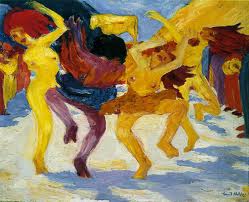
It would seem that singing and music were already a part of the people’s lives prior to the Exodus. We are not told how they knew to sing; we are just told that they sang. What can we learn about music and worship from this scenario that would be applicable to us today?  First, I think we should take note that the natural response to salvation is worship. The people had just experienced a mighty deliverance, and they sang in worship to God. Also, EVERYBODY joined in. It wasn’t just Moses and a select few; “the people of Israel” sang to the Lord. As far as we can tell everyone participated. It seems that no one had the “entertain me” mentality. It was truly a corporate experience.

Furthermore, we observe that this song was all about God. The lyrics exalted the Lord as the only true God, sovereign, holy, and glorious. They are singing to the Lord and about him. The song is prophetic in nature in that it foresees that God will “bring them in and plant them on your own mountain— the place, O Lord, reserved for your own dwelling, the sanctuary, O Lord, that your hands have established.” The first song recorded in the Bible was entirely theocentric. We can also see that at the first “worship service” recorded in the Bible, instruments were used, and dancing took place.

So, although we have only begun our look into the relationship between music and worship, I think we can say the following:

1) Worship (including singing, music, and dancing) is a natural response to salvation.

2) Worship is not a spectator sport.

3) Worship (and the music that accompanies it) is to be 100% God centered.

To be continued…