Election: An Issue of Perspective (Can We Please Move On?)

Something I’m asked quite frequently is my position concerning election- does God sovereignly  choose who gets saved or is man’s free will involved? More often than not I respond with, “Great day man. Is that all you’ve got? Can we please move on?” While there are a thousand different topics I can think of that I believe are far more relevant for us to be talking about, I decided to put my thoughts down in hopes that perhaps someone may be  encouraged in the Lord or perhaps challenged. Alrighty then; here we go.

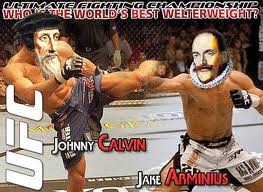
Calvinists and Armenians, whether by their own volition or some secret decree (that’s supposed to be a joke), are comprised of individuals adamant as to their respective doctrines concerning election. I believe that this stringency, in many cases, has resulted in men becoming more interested in proving each other to be in error than in the furthering of the Kingdom of God. The perspectives of many have become distorted and clouded in the mist of contention. And it is perspective itself which must be considered, in my opinion, when one seeks to understand the biblical doctrine of election. In that man is creature and not creator, the ability to completely perceive as God perceives is, without question, impossible. Yet, to understand divine providence, one must attempt to see things the way God sees them. The sovereignty of God and the free will of man merge into a natural, yet incomprehensible synthesis as they are both absorbed into the perspective of the divine.
The Bible teaches that God is an eternal being without beginning or end. For God, there was no then,  and there is no tomorrow. The Almighty inhabits the realm of now in which there was never a moment at which He comprehended. He is the great I AM. We are told that God is the One who declares the end from the beginning (Isa. 46:10). The terms end and beginning are not meant to be understood as applicable to God’s perspective, rather they are used to communicate divine perspective to a finite, “time-bound” creature.

Within the Bible there are various passages that give insight into the divine perspective. One finds in the book of Revelation that Jesus was/is “the Lamb slain before the foundation of the world” (Rev. 13:8), yet, “in the fullness of timehe appeared upon the earth (Gal.4:4).  David claims that the Lord had ordained all the days of his life before he was ever born (Ps. 139:16).  One repeatedly finds instances contained in scripture in which God is depicted as having intimate knowledge of an individual prior to their birth (Jer. 1:5). Still, there was a time and place that their lives were manifested upon the earth, that which God knew completely from all eternity realized in time and space. These are only a few among the many  scriptures that give a glimpse into the eternal divine perspective.

I believe that God created all things in one “motion.” There was no beginning or end, no point at which it all started. To limit God to a point would be to confine Him to space and time thus rendering Him not God. There was never a moment, much less a moment in which He did not fully and completely have intimate knowledge of all that would be- the Lamb is slain, all who would be saved are, all who will be lost are. The divine perspective requires no point in time in which man chose or rejected, and I think  that “election” and “free-will” are time- space oriented discussions we have in an effort  to explain the physical manifestation of the divine perspective invading a created reality.

Well, that’s my two cents regarding election.  Let me add that I think that it is to our shame that so many within the church have become worshipers of men and the doctrines of men. Don’t get me wrong, we are told in scripture to have sound teaching, and the importance of that cannot be stressed enough. It’s only that so many can quote verbatim the various tenets of their favorite theologian, but when you ask them what the Lord has spoken to them recently, they look at you as if you are insane.  Pardon my English, but that aint cool. Sadly, for so many who claim to be Christian, knowing Jesus is just an academic exercise. Perhaps it is the lack of true intimacy with Jesus that has lent  to all of this empty pursuit of what we falsely call knowledge. What I mean is, if you aren’t really captivated and enthralled by Him; I guess you have to spend your time doing something. Listen, I am a student of theology and don’t believe for a second that you are required to discard your brain when you come to Christ. However, if all your “knowledge” isn’t moving you to closer intimacy with Jesus, it’s worthless!

The church owes much to theologians like Calvin and Arminius, men who spent their lives in diligent study of the Bible and the formulation of theology. However, in the end, even the greatest minds are limited in their perspective. May our perspective be that which comes from having our eyes fixed on Jesus, and not merely from having to prove a point.

(Oh, so you’re not satisfied. Which is it you ask, the sovereignty of God or man’s free will? Well, the answer is yes.)


Discernment & Priorities

Those who know me know that I believe a Christian is to influence his culture by preaching (preach the gospel, use words when necessary) the gospel. I believe that cultures and nations for that matter are transformed through the establishment of the kingdom of God within the lives of people transformed by Jesus, rather than by so called Christian political activism. However, I must say that through the political process, at least the priorities and lack of discernment of many who name the name of Jesus is being revealed.

Some support a candidate merely because he is of their same ethnic/racial orientation. And sadly, there are some who will oppose a candidate because he is not of their race. They have forgotten or perhaps never learned that “in Christ,” there is no Jew, Greek, nor White, or Black. This choosing of a candidate because “He is one of our people,” or rejecting him because he is not reveals a carnal disposition. Let us repent and seek forgiveness and healing. Christian, we are not called to be “strong, proud white men” or “strong, proud black men”; we are the body of Christ and joined together as one new man in Jesus. Will you not just be a “Jesus man”?

Some Christian political activists assert that President Obama is a closet Muslim or perhaps even the antichrist. They fear that he and the left are doing all they can to destroy Christianity and destroy the United States. Strangely, their solution is to join forces with another candidate whose religious beliefs are cultic in their origin. Christian, how much have you studied Mormonism? What would cause a Christian to reject one candidate on the grounds that he is not Christian and bent on destroying the nation, and then choose another candidate who is not Christian and trust him to save the nation? Could it be lack of discernment and misplaced priorities? I shudder at the thought of even deeper implications.

Brothers and sisters, for you, as Christians; the answer is not to be found in a political party or candidate. Our hope is in the Lord. Let us not be like the ancient children of Israel, who when faced with God’s judgment sought after political alliances with the nations, believing they could save themselves and their nation by the arm of the flesh. Instead, let us repent of our idolatry, of murdering our babies, cheating on our wives, spending hours looking at porn on the internet, getting high, etc…   Let us prayerfully search the scriptures, and cry out to the Lord that he may give us his priorities and true spiritual discernment for this hour. Let us wait before him on our knees until he fills our hearts with prayers birthed by his Spirit. Let us deny ourselves and take up our cross. Let us extend Jesus to a lost and dying world.

With This Ring (conclusion): The Holy Spirit as our “Arrabon”

(In the final installment of this series, we take a closer look at the “engagement ring” the Church has been given in the person of the Holy Spirit.)

It is important to keep in mind that until the time of Christ, the Jews had only known the Holy Spirit as an impersonal, invading force. He was seen as the mysterious power of God who, at times would come upon an individual in order to equip them for a specific purpose during a limited amount of time. The Jews looked upon the Holy Spirit as the mysterious ruach, the breath and wind of God. He was, to Jew, the active power of the Lord God.[1] The Jews knew that there would come a day in which the Lord God would “sprinkle them with clean water, and put his Spirit within them” (Ezekiel 36), but they had no conception as to the intimacy this indwelling Spirit would represent. But now, Messiah had come, the spirit-man had been revealed as the unique dispenser of the very Spirit of God; and, the Holy Spirit would no longer be seen as the raw, naked power of God, he would be forever clothed with the personality and character of Jesus.[2]

Paul had now come, having received the revelation that this Holy Spirit was the “other” Comforter and Teacher that Messiah had promised, and he is given to those who believe, Jew and Gentile alike, as an arrabon, assuring them that God would indeed be faithful to bring about a complete consummation of all he had promised. Because of this arrabon the very love of God had now been “shed abroad” in their hearts; they had received the Spirit of adoption which created within them a desire to cry out, “Abba.” This same Spirit would bear witness within their own hearts that they were indeed children of God. The Spirit, who had been given to them as an arrabon, would comfort them and teach them, his presence within them providing assurance as to the complete redemption “of God’s own possession, to the praise of his glory.”

The Spirit has been given as a pledge or deposit guaranteeing the full realization of God’s redemptive purposes. One could say, in light of what has been discussed in the writing at hand, that the church has been given a wonderful engagement ring by her Lord. For our purposes let us imagine that this ringis a magnificent four carat arrabon and that each carat represents four different aspects of the arrabon in relation to the believer.

The first carat represents the adoptive aspect of the arrabon. Although it was uncommon for Jews to practice such adoption, it was nevertheless common for the emperors of that period to adopt from outside their immediate family and acquire a successor in this way. Our arrabon accomplishes and provides to the believer sonship and all the advantages that go along with it.

The second carat is complete assurance that the believer does indeed belong to Christ. This carat speaks of belonging and provides evidence to the believer and those on the outside that he is the property of God; and as the arrabon proves the reality of the relationship of the recipient to the giver of the arrabon at the present, it proves that the relationship will be consummated in the future.

The third is an aspect of “first fruits”. Christ has risen from the dead and the believer has promise that he himself will share in this glorious resurrection in which mortality is swallowed up by immortality.

Finally, the arrabon is assurance itself. The Holy Spirit is in the believer and he speaks of Christ with absolute assurance and conviction. This assurance is beyond mere intellectual affirmation; instead, the arrabon is an absolute convincing experience, alive within the believer.[3]

The New Testament refers to the church as the bride of Christ; and, her beloved has provided her with the most glorious arrabon ever to be received. As she waits for her husband to return and receive her unto himself, as the wedding day is delayed and times become dark and discouraging, she has only to look upon the arrabon to be assured of his love and faithfulness; and, the cry of her heart becomes, “The Spirit and the bride say come.”


 1. Michael Green, I Believe in the Holy Spirit (Grand Rapids, Michigan: William B Eerdmans Publishing Company, 2004), 20-36.

2. Ibid., 50.

 3. Ibid.,100-102.

With This Ring (part3): The Holy Spirit as our “Arrabon”

(In part three we continue to explore the idea that by giving the Spirit as an arrabon, the eternal Lord and master of all creation has, in effect, said to his beloved, the church, “With this ring, I thee wed.”)

It is clear that the usage of arrabon was prevalent at the time the Apostle Paul wrote his letter to the Ephesians, and if one accepts as fact divine inspiration in regards to the writing of scripture, one can quite logically infer that God himself inspired Paul to use the term arrabon, and that it has been purposefully selected to reveal an aspect of the Holy Spirit which had heretofore been unrealized. Keeping in mind the etymology and colloquialism of arrabon, as well as its pertinence within modern society, the theological impact of the Holy Spirit given as an arrabon becomes readily apparent and the significance of this act within the life of the believer reveals promise both for the present and the future.

Paul tells us in his letter to the Ephesians, “In Him [Christ], you also, after listening to the message of truth, the gospel of your salvation–having also believed, you were sealed in Him with the Holy Spirit of promise, who is given as a pledge of our inheritance, with a view to the redemption of God’s own possession, to the praise of His glory.” (Ephesians 1: 13, 14 NASB) So far, we have established the definition of the term arrabon by exploring its etymology and the colloquialism of the period in which Paul used it.  We have learned that it is something given to an individual, “in earnest”, in assurance that full consummation will occur. Now we seek to understand the theological ramifications of this most blessed arrabon. It is perhaps a common practice among writers to bring the reader along a thoughtfully laid out path of evidential citations, making use of the volumes of academic wrote, and gradually build up (saving the best for last) to a point of climactic proportion in which the reader is finally possessed by rapturous comprehension as to the writer’s assertions. However, in the case of arrabon, the magnitude and wonder of all it represents, presents the writer with such a plethora of glorious implications that one scarcely knows where to begin. There is no need to save the best for last; as the term arrabon itself implies, “We may begin here, at this point; but, it only gets better.”

Michael Green has grasped the reality of arrabon and so he tells his readers that the Holy Spirit is a real part of the age to come, that the believer possesses right now! He refers to the Holy Spirit as the engagement ring that assures us that there is so much more to come. The Spirit is God’s “first installment”, a down payment of the future salvation we will inherit. The Holy Spirit is a part of the future, now!  “He [the Arrabon] is the heavenly Lover’s engagement ring given to us. We shall carry that engagement ring with us into God’s future, when we have the full wedding ring of final union with Christ.”[1]  This life we have in the Spirit, this arrabon we have been given, is, in fact, a taste of heaven, a likeness of the life we will have when our union with Christ is consummated.

Imagine the sublimest, most treasured experiences of the Holy Spirit we have ever had and then realize they are only a foretaste, the tip of the tongue on the spoon, of what is to come. Remember the release in coming to Christ and knowing you were forgiven? Remember that time when in worship you were smitten with awe?  Remember that time you followed the Spirit’s leading and were wonderfully used? Remember the satisfaction of finding the fruits of the Spirit with goodness   where you once responded wickedly? Think of all this and then multiply it a  millionfold. Here, on earth, we have experienced the first dollar of a million celestial dollars-the earnest. We have the dawning of knowledge, but then we will have the midday sun.[2]

Paul, in several passages of the NT, speaks of an inheritance which those in Christ have received. The Apostle Peter echoes this fact, assuring believers that there is indeed an inheritance which awaits them, an inheritance which is “imperishable and undefiled and will not fade away, reserved for you in heaven.” (I Peter 1:4 NASB)  Indeed, much has been written in regards to the believer and his future in God. Jesus himself said that the glory that God had given him, he gave to the believer. (John 17:22 NASB) The Bible speaks of “Christ in you, the hope of glory.” (Colossians 1:27 NASB) The Bible says that when Christ appears, the saints will also appear with him in glory. (Colossians 3:4)  The Shekinah glory of God will be seen in every believer, we will indeed “reflect the glory of his grace”. “The believers inheritance is God himself and all that God bestows.”[3]  The arrabon received serves to affirm that the full inheritance will indeed be procured.

It is impossible, in our present context of mortality, to grasp the full implications of our inheritance in Christ. One can recount all of the promises of God and try to conjure images of what it will be like to physically be in his presence, yet our limited perception prohibits us from appreciating or comprehending the reality of such an inheritance. In fact, the magnitude of such an inheritance, compounded with the finite limitations of human apprehension, can reduce one to speculating as to whether or not such a thing can be true- ARRABON! Our wonderful savior did not leave us with a mere promise and an exhortation to “have faith”; he has given an arrabon whereby we may now, at this present time, experience an infinitesimally small portion of the full inheritance that awaits us at the consummation of the eschaton. The Spirit of the new age has indeed broken in upon the old. This arrabon is the first installment of the believer’s inheritance in the kingdom of God.[4]

To be continued…


                18. Michael Green, I Believe in the Holy Spirit (Grand Rapids, Michigan: William B Eerdmans Publishing Company, 2004), 101,102.

                19. R. Kent Hughes, Ephesians: The Mystery of the Body of Christ (Wheaton, Il.: Good News Publishers, 1990), 46.

                20. Lewis Sperry Chafer, Systematic Theology: Volumes 3&4 (Grand Rapids, Michigan: Kregel Publications, 1976), 261.

21. Veli-Matti Karkkainen, Pneumatology: The Holy Spirit in Ecumenical, International, and Contextual Perspective (Grand Rapids, Michigan: Baker Academic, 2002), 33.

With This Ring (part2): The Holy Spirit as our “Arrabon”

(What did Paul mean when he referred to the Holy Spirit as our Arrabon ? Does the term arrabon have any special insight to offer as to the Father’s intentions regarding the Church?  In part two we go a little further in our attempts to gain new perspective into the wonderful gift God has give us.)

“The word arrabon has one of the most human and interesting backgrounds of all NT words.”[1]

The word is very common in the papyri in business documents and agreements  Milligan quotes some very interesting usages of it. We take three of them as    examples. A woman selling a cow and she received one thousand drachmae as an arrabon that the remainder of the price would be paid. Certain dancing girls were being hired for a village festival and they are paid so many drachmae in advance  as an arrabon, with proviso that this already paid sum will be taken into account when the final payment is made after the performance has been given. And-a rather amusing instance-a man writes, ‘Regarding Lampon, the mouse catcher, I  paid him for you as arrabon eight drachmae in order that he may catch the mice  while they are with young.’[2]

A tablet was found at Pech-Maho, a fortified trading post occupied from sixth century BC to the third century BC, and is “particularly revealing, because it involves an agreement between people of different origins, as is clear from the names. Witnesses are invoked and an arrabon is given as a pledge. ‘The pledge [arrabon] I handed over where the boats are moored…Basigerros and Bleruas and Golo.biur and Sedegon; these were [witnesses] when I handed over the pledge.’”[3]  Parchments [shopkeeper’s accounts] dug up in the sands of Egypt revealed that arrabon was the word used “for cash on deposit, a pledge for a bill that you would pay at the end.”[4]  The populace of the first century would have been well acquainted with the term arrabon.

  In the first century – an arrabon – αρραβων – bound someone legally to the  complete purchase…  Now the New Testament was written in the common,  ordinary language of the people of that era – in what is known as Koine-Greek.  “Koine” is a term that means “common.” So the term “Koine-Greek” means “Common Greek” indicating it was the commonly used Greek language… Now although arrabon was only used three times in the New Testament, it was a  common word used daily in the lives of everyone living in the New Testament   era.[5]

and again,

In the last seventy-five years through the discovery and examination of countless“ordinary” documents of the time of Christ, we have been able to recapture   something of the language of the day: in bills and receipts, deeds and grocerylists, in letters from traveling fathers, anxious mothers, and prodigal sons. Let us look at just one example. The idea of buying on the installment plan, with a small  initial down payment, is nothing new. Contracts and bills of sale from the first century record such transactions and specify the down-payment which seals andbinds the contract; the word used for this initial payment is “arrabon,” the very  word…[6]

It is worth noting that although one may be tempted to make comparisons between arrabon and terms used in modern society, such as “down payment”, there really is no justification for the comparison. In today’s down payment arrangement, one may decide to forfeit on the desired purchase; on the other hand, an arrabon was/is legally binding. There really is no adequate English terminology that fully captures the significance of arrabon.[7]

    Arrabon, its etymology and employment within the vernacular of the first century has been adequately considered, but it should be noted, at this point, that the term is also still used in today’s modern Grecian culture and this is of particular interest to this writer in that its contemporary usage, while definitely retaining the aspect of something given at the present in assurance of future consummation, possesses a distinctively intimate quality as well. The arrabon of modern Greece has to do with the engagement period prior to an actual wedding.

Among the Greeks, the arravon [arrabon] is the betrothal period, and is itself a formal ceremony. It takes place among the relatives of the contracting parties, and is looked upon almost as binding as the actual wedding itself.[8]  “If we went to Greece today and met an engaged lady and asked to see her arrabon, she would put out her hand with an engagement ring on it.  In modern Greek, that is what the word means.”[9] In the opinion of this writer, it would be redundant to cite the many references available as to the present day usage of arrabon. Scholars such as John MacArthur[10] and Michael Green[11] all attest to the fact that arrabon is the term used today, among modern Greeks, when referring to wedding engagement. It is this aspect of arrabon that prompted this writer to choose the title he selected for the writing at hand. The idea that by giving the Spirit as an arrabon, the eternal Lord and master of all creation has, in effect, said to his beloved, the church, “With this ring, I thee wed.”

To be continued…


7. William Barklay, New Testament Words, (Louisville, Kentucky, John Knox Press, 2000), 58.

8. Ibid., 58, 59.

 9. William Allen Johnson and Holt N. Parker, Ancient Literacies: The Culture of Reading in Greece and Rome, (New York, Oxford University Press, 2009), 26.

 10. Lesslie Newbigin and Paul Weston, Lesslie Newbigin: Missionary Theologian: A Reader, (Grand Rapids, Michigan, Wm. B. Eerdmans Publishing Company, 2006), 138.

11. Richard Coombes, “Biblical Vocabulary Term: Arrabon,” Alpha Omega Report (2009) http://aoreport.com/ao/biblical-studies-mainmenu-68/1265-biblical-vocabulary-term-arrabon, (accessed March 21, 2011).

  12. Joel Frank, “The Use of Modern Translations and Their Effect in replacing The King James Version,” wlessays.net (1971) www.wlsessays.net/files/FrankModern.rtf, (accessed March 21, 2011).

  13. Richard Coombes, “Biblical Vocabulary Term: Arrabon,” Alpha Omega Report (2009) http://aoreport.com/ao/biblical-studies-mainmenu-68/1265-biblical-vocabulary-term-arrabon, (accessed March 21, 2011).

14. Lucy M. Garnett, “The Christian Women of Turkey,” Womanhood Vol.3 (December, 1899-May 1900): 340.

 15. David Eckman, “Life Solutions Series on God The Trinity: God The Holy Spirit,” BWGI Ministries (2005) http://www.whatgodintended.com/content/god-spirit.asp, (accessed March 23, 2011).

 16. John MacArthur, Galatians: New Testament Commentary (Chicago, Il.: Moody Publishers, 1987), 66.

17. Michael Green, I Believe in the Holy Spirit (Grand Rapids, Michigan: William B Eerdmans Publishing Company, 2004), 101.

With This Ring: The Holy Spirit as our “Arrabon”

(A while back, I wrote a paper on Paul’s referring to the Holy Spirit as our Arrabon. Arra-what? Well, I’m glad you asked! I believe if you’ll take the time to read the next few “With This Ring: The Holy Spirit as our Arrabon” posts, you will gain new perspective as to the wonderful gift God has given to us in the Holy Spirit.)

The doctrine of the Holy Spirit, to be sure, is one that cannot be made to fit within a nicely packaged theological box. Volumes have been written in efforts to explain and comprehend the workings of the third “person” of the Trinity, and yet we find that even the Bible itself does not present us with a systematized outline concerning the Spirit; but rather teaches us about the Spirit through symbols and stories, concentrating more upon the work of the Spirit than anything else.[1] However, the Apostle Paul does give us a distinctively clear insight into one aspect of the Spirit’s work within the believer when in two of his epistles, he refers to the Holy Spirit as a pledge or arrabon, which God has given to the believer.  It is to this concept of the Spirit as the arrabon that we shall devote the content of this manuscript.

The usage of the word arrabon within the New Testament is distinctively Pauline,“…and it was a favorite of his because he uses it three times, always in the same connection. In II Cor. 1.22 he says that God has given us the arrabon of the Holy Spirit in our hearts. In II Cor. 5.5 he again talks about the arrabon of the Holy Spirit. And in Ephesians 1:14 he speaks about the Holy Spirit being the arrabon of our inheritance.”[2]  Arrabon, within the context of the aforementioned scriptures, seems to contain within it not only an aspect of the Spirit as the believer relates to him presently, but also an eschatological relevance as well. This arrabon is now a present reality, but his presence is indicative of the fact that there is more to come. There is a now, but not yet element in the word arrabon, and the propensity Paul had towards using the term peaks curiosity and incites a desire to further explore its connotations. However, before the theological implications of arrabon are explored, an excursion into its more practical aspects must be made.

Paul taught that he was teaching doctrine that had previously been hidden, and had been given to him by Jesus, through revelation( I Cor.2:7; I Cor. 11:23;Gal. 1:12). So, it behooves the sincere student of the Bible to carefully consider why Paul would use such a word as arrabon to describe the Holy Spirit. To understand the Apostle Paul’s affinity for the word arrabon, the etymology of the word must surely be considered, and the relevance which the term held for those who lived during the time of the apostle must also be comprehended.

According to James Wareing Bardsley ,

…arrabon, is doubtless of Phoenician origin. It originally signified the pledge or pawn which gave security to contract…As the Phoenicians had trading transactions with almost every part of the Mediterranean Sea, the word “arrabon”  became one of universal acceptance, just as the word “tariff,” derived from the Spanish traders, is found in almost every modern language. When the Greeks, however, adopted the term, they gave it a distinct and technical meaning. It was   not merely a pledge or security, it was something more; it signified the deposit  paid by a purchaser on entering into a contract for the purchase of anything.[3]

Raymond F. Collins shares Bardsley’s convictions that arrabon is a term taken “from the economic sphere, the world of financial transactions… [and] most likely of Phoenician origin;”[4]  Geoffrey Bromiley also concurs that “…arrabon is a commercial loanword from the Semitic [Phoenicia is included in this grouping] signifying “pledge” or “deposit”.[5]  In his book, Ephesians, Ernest Best lends his affirmation in attesting to the fact that the word arrabon “is a legal and commercial term of Semitic origin adopted into Greek which commits both giver and recipient to the completion of a deal under penalty. Yet the earnest is not just a pledge or guarantee that something will be given later; it is itself a partial gift…”[6] Among scholars, it seems to be the view of the majority that arrabon is Semitic in origin and its usage always contains some sort of commercial quality. Further citations could indeed be provided as to the origin of the word arrabon; but due to the brevity of this paper it is this writer’s hope that the reader has been given sufficient evidence as to verify arrabon’s etymology. But, is there documentation available that would indicate the colloquialism of arrabon during the time of Paul? Let us now turn our attention towards the manner in which arrabon was used in the vernacular of the first century.

To be continued…


            1.  Veli- Matti Karkkainen, Pneumatology, (Grand Rapids, MI – Baker Academic, 2002), 23.

2. William Barklay, New Testament Words, (Louisville, Kentucky- John Knox Press, 2000), 58.

                3. James Wareing Bardsley, Illustrative Texts and Texts Illustrated, (London, James Nisbet & CO., 1873), 223,224.

4. Raymond F. Collins, The Power of Images in Paul, (Minnesota, Liturgical Press, 2008), 153.

5. Geoffrey William Bromiley, Theological Dictionary of the New Testament, Volume 1, (Grand rapids, Michigan, William B. Erdmans Publishing Company, 1985), 80.

                6. Ernest Best, Ephesians, (New York, T&T Clark International, 1998), 151.

Show & Tell

Maybe it is especially so here in America, but so often, when talking to others about what they believe God has called them to; it is usually something grandiose. Perhaps it is our culture, but it seems we all have illusions of grandeur, some type of ministry involving a large international stage, CD’s, fortune and fame- all for Jesus of course. Yet when Paul was writing what were among his last words to Timothy, he simply told him, “… and what you have heard from me in the presence of many witnesses entrust to faithful men who will be able to teach others also.” (II Timothy 2:2)

In a success driven culture in which even the church has adopted the “if it aint big it aint God” mentality, it would seem that we have forgotten that perhaps the greatest thing we can hope to do is to simply teach others what it means to follow Jesus. You know, Timothy was Paul’s protégée, and you would think as the “heir apparent” he was being groomed to be the next big thing. But, when you read the letters Paul wrote to young Timothy, you find that over and over again, his resounding admonition to Timothy was, “Just teach them the truth!” (Oh, there’s also the bit about enduring hardship and suffering as well.) Sadly, we spend so much time dreaming of that “big ministry” God has called us to that we neglect teaching the people we spend time with each week what it means to truly walk with the Lord. We tell the Lord, “Give me nations!” And he asks, “What about the people I’ve already given you? Will you make them my disciples?”

Here’s the deal: Abide in Jesus, learn what it means to walk with him, and then; teach others what you’ve learned.

“A faithful, sensible servant is one to whom the master can give the responsibility of managing his other household servants and feeding them.”

Disillusioned: The Jesus Drug

Why do people use drugs? Well, you’ll get a lot of different answers to that question, but the bottom line is that people who use drugs, for whatever reason, find that their every day life is not satisfactory; therefore, there is a need for something more. It may sound crazy, but there are countless Jesus Drug addicts among us today. The Jesus Drug, just like illicit drugs, comes in a variety of forms, tailor made to suit the varying personalities of the addict. As with the abuse of narcotics, the Jesus Drug promises a never-ending high, enhanced self-esteem, and a host of other empty promises just as long as you continue to use it. Be careful though, it’s easy to get hooked, and you can get a fix on about any corner.

Jesus Drug addicts (like all addicts) come in all shapes and sizes. There are the Mystical Addicts who are hooked on that next “deep experience” with Jesus. There are the Prophetic Addicts that see Jesus as a means by which they will be lifted up to some kind of mind-reading, avenger like character. Then you have your Political Jesus Junkies, hooked on taking the country back for Jesus. Down the street, lives the Postmodern Jesus Drug addict, unsure of anything accept the fact that it is everyone else who is addicted. Then there are the I Hate the Organized Church addicts, high off of the twisted euphoria of bitterness. There are the Traditional Jesus Drug addicts still mainlining the religiosity of days gone by, hooked on form without substance. We mustn’t forget the Intellectual Jesus Drug addict, numbed to any form of emotion, ingesting his daily dose of dead religion.   I could go on, but you get the picture. When you talk to Jesus Drug addicts they rarely talk about anything (including Jesus) other than their drug of choice. They are disillusioned with their relationship with Jesus, and have come to the conclusion that there must be something more. Perhaps it is the fact that they never have truly understood what knowing Jesus is all about, or perhaps the religion being offered by your typical institutional church has failed to deliver, but whatever the cause; the Jesus Drug addicts are continuously chasing the next self-affirming spiritual high and selling their souls to get it.

Ask an addict and he’ll tell you that it’s not the getting high part that’s the problem; it’s the coming down. Many within the church today are experiencing withdrawal from the Jesus Drug, and like all addicts, the crash is leaving them confused and wondering what to do. They know that something is wrong. The Jesus Drug has failed to deliver the intimacy with Christ they craved when they first came to the Lord.  As a former addict myself, I can tell you that the first step is honesty. If you begin to sense in your heart that you may be a Jesus Drug addict, come clean. The fact that you are aware that there is a problem means that God’s Spirit is at work. Yeah, your pride will be hurt, but that is exactly what has to be crushed because it is the belief that somehow you deserve a little more that led to your being an addict in the first place.

Can I ask you something? Are you in love with Jesus or simply hooked on the Jesus Drug? Has your addiction to the Jesus Drug reduced your relationship with Christ to merely something that makes you feel better about yourself?  God has provided an awesome one step program for the Jesus Drug addict, and it is the Cross of Jesus. We go to the cross believing that God will not reject the broken and contrite heart that has been crushed and torn apart by addiction to the Jesus Drug. We go to the cross and confess that we have seen Jesus as a means of healing our broken egos and fixing our low self-esteem instead of acknowledging him as Lord. Frankly, the only cure for the Jesus Drug addict is Jesus himself. Come, taste and see that the Lord is good, and he is all you truly need.

The Best Kept Secret Regarding Worship: Bible Study

Did you know that the Rabbis view the study of the Torah (first five books of the Old Testament) as the highest form of worship? One early Rabbi said, “When two sit together and exchange words of Torah, then the divine presence dwells among them.” That sounds vaguely familiar doesn’t it? Jesus said, “Where two or three are gathered in my name, I am there in the midst of them.” Yeah, the Rabbis say that when you pray, you are talking to God, but when you study Torah, God is talking to you. Isn’t it strange, so many of us claim that we never hear God speaking to us when He has provided a book with about 774, 746 of His words that will speak to us as often as we will read them?

When it comes to worship, we place so much emphasis on relevance, worship music, worship style, and whatever else you can think of, but it seems we have overlooked the very important fact that Bible study itself is worship. You’ll hear it said in our churches, “Well, we’ve had a wonderful time in worship today; now let’s turn to the Word.” (Insert wrong answer buzzer sound effect.) No, studying the Word is worship!

After God had delivered the people of Israel out of the land of Egypt, they traveled in the desert for a long time. As they made their way, God told them how he was to be worshiped. He had laws for this, ceremonies for that, different sacrifices and feasts, and at the center of it all was the Shema. Check out Deuteronomy 6:4-9:

“Hear, O Israel the Lord our God, the Lord is one. You shall love the Lord your God with all your heart and with all your soul and with all your might. And these words that I command you today shall be on your heart. You shall teach them diligently to your children, and shall talk of them when you sit in your house, and when you walk by the way, and when you lie down, and when you rise. You shall bind them as a sign on your hand, and they shall be as frontlets between your eyes. You shall write them on the doorposts of your house and on your gates.”

Can you see the application in this for us 21st century Gentile Christians?  Can you see the relationship between loving God, and God’s Word? The Israelites were to give prominence to God’s word in their lives, and so are we. In fact, if we are not interacting with the Word, if we are not spending time studying the Word; our worship is incomplete.  Just read Psalms119, and you’ll get a clear picture of how the study of God’s word was looked upon as worship. I know it’s unpopular to tell Christians that they must do something. I know we don’t like to hear that we must study. After all, that sounds so Pharisaical. We have reduced worship to merely being entertained, getting’ my praise on, and all of that kind of thing. The truth is that part of our worship is studying God’s word. The reason that deception and apathy are rampant in the churches of America today is due largely to the fact that we have failed to teach our people that the study of God’s word is every bit a part of worship as prayer and singing songs! So what, Shema, Shema you say. That’s that Old Testament legalistic stuff; we’re under the new covenant brother. It’s all about grace and mercy, and we don’t have to do anything.

Jesus himself said that man lives by every word that God speaks (Matthew 4:4). Jesus even said it is those who hear his words and do them that are truly his family (Luke 8:21). How are we to hear and do today? It is in worship, studying his Word. We are exhorted to study God’s word knowing that the scriptures were breathed out by God as he used men to write them down. It is in our worship time of studying the Word that we are made complete and equipped for every good work (II Timothy 3:16, 17). In his encounters with the Jews of his day, Jesus didn’t condemn them for the emphasis they placed on the scriptures; he rebuked them for failing to understand that it was the scriptures they claimed to love so much that testified of him. This brings me to my next point. Our worship through studying the Bible is to lead us into a living encounter with Jesus. You know, maybe we need to reexamine our definition of “Bible study.”

For so many Christians, Bible study has been reduced to the time they come to church, get situated in their seats, and listen to someone else tell them what the Bible means. I think somehow we’ve missed something. Glance back up at the scripture we looked at in Deuteronomy 6, notice how it speaks of Bible study in an organic way. It was discussed as they were together, as they moved, as they went about living. It was not a static experience; it was a living thing they experienced together. Yes there were teachers, scribes whose job it was to teach the Torah, and we have been given Apostles, Prophets, Evangelists, Pastors, and Teachers to teach and equip us as well. However, the normal Christian experience is not to come to church, plug in and get the latest download. We are to spend time in personal worship, personal study of the Word, but we are to interact together, experiencing God’s Word together. As we do this, the Holy Spirit glorifies Jesus, and we become built up and encouraged in the Lord. Remember the words of Paul found in Colossians 3:16, “Let the word of Christ dwell in you richly, teaching and admonishing one another in all wisdom, singing psalms and hymns and spiritual songs, with thankfulness in your hearts to God.” And again, in his words to the Corinthians, “What then, brothers, when you come together, each one has a hymn, a lesson, a revelation, a tongue, or an interpretation. Let all things be done for building up” (I Corinthians 14:26). Our time spent in personal worship, in personal Bible study is to be that which the Holy Spirit later uses to minister to our brothers and sisters when we come together.

In II Timothy, we find Paul at the time immediately preceding his death. He would soon be beheaded; it was only a matter of weeks or perhaps months. He was in a Roman prison and writing what was to be among his final words, he said to Timothy, “When you come, bring the cloak that I left with Carpus at Troas, also the books, and above all the parchments” (II Timothy 4:13).  We don’t know for sure which books, which parchments he was referring to, but I wonder if maybe he desired to have portions of the scripture with him. Maybe there was an old copy of the Septuagint (Greek translation of Old Testament) he wanted to have with him. Knowing how the Jews (especially a man like Paul) viewed Torah study, I wonder if perhaps being in that prison, that old beat up body of his made it difficult to bow, to kneel, and maybe he figured, “I’ll offer you my worship by studying your word Lord.” Maybe, I don’t know.

Yes, we must worship through prayer, in singing, and in countless other expressions the Spirit may birth in our hearts, but let’s not forget that the study of God’s word is every bit as much a part of worship as those things are. Hear me friends, there is going to be ever increasing deception as this age draws to a close. Be complete in your worship. Spend time in God’s word, and as you do; you will encounter the risen Lord.

The Roots of the Emergent Church Movement (Full Documentary)

As I said in Postmodern Reflections (part 1) : The evolution of society from modernity into postmodernity has produced reverberations within the church that indeed may prove to be eschatologically significant. Throughout its history the church has faced many heresies. Counsels have been convened for the purpose of discerning truth and setting forth orthodoxy. But, how does the church minister to a culture that insists there are no absolute truths to be discerned. What is the response of the church to be to ones who can say that while God has indeed acted uniquely in the person of Christ, he is also present and active in other belief systems as well? As the church finds its very institutional foundations shaken to the core, its evangelical practices touted as archaic, and the very message of the cross held in contempt; the Emergent Church has risen to the forefront. Adopting a postmodern philosophy, the Emergent movement has reduced the gospel of the Kingdom to a call for community, social-justice, and political activism. The Jesus of the postmodern emergent “Christian” is nothing more than a community organizer intent on assisting men in living together in mutual inclusion as they discover the validity of their respective cultural context belief systems and the God who is at work within them.

With that being said (again), I came across this documentary and wanted to pass it along. This is a full length documentary entitled “The Roots of the Emergent Church Movement,” and I truly believe it will greatly benefit you. It is my prayer that you will take the time to prayerfully watch this film, and search the scriptures for yourself to see if these things be so.